SUPREME COURT KO'S RACIST LAWS LIBERALS LOVE
STRIKING DOWN HAWAII'S DE FACTO BAN ON CARRYING GUNS IN PUBLIC, HIGH COURT REJECTS 'BLACK CODES,' PROTECT RIGHTS OF DISFAVORED, MINORITY GROUPS TO OWN GUNS
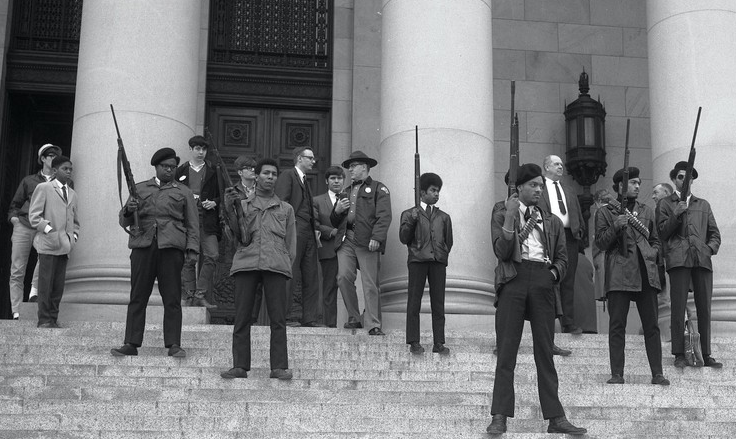
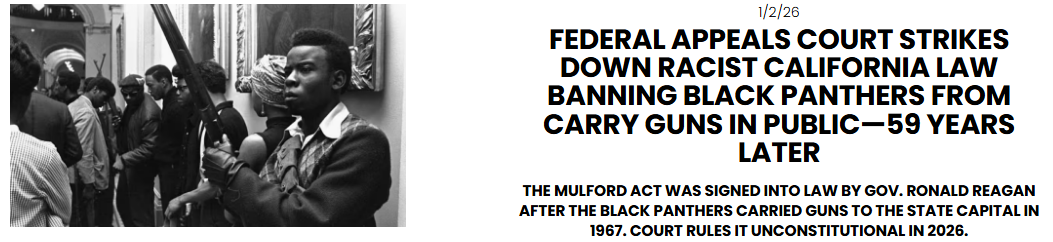
Black Panthers at the California State Capital.
MALONE, NEW YORK JUNE 25, 2026
A Hawaii law that effectively stripped Americans of the Second Amendment right to carry a gun in public was struck down by the US Supreme Court on Thursday.
"This regime hobbles what the Second Amendment protects: the right of Americans to carry arms for self-defense as they go about their daily lives," the Court's 6-3 majority opinion begins. "We hold that the law is unconstitutional."
The decision highlights the role racist 19th Century laws have been used by Liberal Attorneys General and judges to gut the individual constitutional right to keep and bear arms the Supreme Court first recognized in 2008.
The Hawaii law at issue in the case, Wolford v Lopez, made it a crime to carry a firearm onto private property held open to the public—like gas stations, grocery stores, restaurants and hotels—without the express and affirmative consent of the property owner.
The law was part of a host of laws enacted by the Hawaii legislature after the US Supreme Court ruled Americans have the Second Amendment right to carry a gun in public in its 2022 decision in New York State Rifle & Pistol Association v Bruen. Before the decision, only four people had been granted firearms carry licenses in Hawaii between 2000 and 2018, according to court records.
In an attempt to basically overrule Bruen by legislative fiat, Hawaii lawmakers flipped the historical, common law presumption that everyone, including those lawfully carrying firearms, may enter a privately-owned space held open to the public unless expressly prohibited from doing so.
The new law created a legal presumption that no one carrying a firearm can enter such a space without the property owner’s express authorization. The presumption was enforceable by criminal prosecution and punishable by up to one year in jail—even if the violator had a valid firearm license.
Under Bruen, the 2022 Supreme Court decision that recognized a Second Amendment right to carry a gun in public, courts faced with constitutional challenges to laws that restrict gun possession must examine whether the challenged law is “consistent with the Nation’s historical tradition of firearm regulation.”
If they are, they’re constitutional. If they’re not, the violate the Second Amendment and are illegal.
After Hawaii gun owners sued and challenged the new law in federal court, Hawaii's Liberal Attorney General Anne E. Lopez cited racist laws from the 19th Century called "Black Codes" that disarmed freed Black slaves to argue that the new law was “consistent with the Nation’s historical tradition of firearm regulation" and thus legal under Bruen.
Lopez is not alone in having argued that the racist Black Code laws justified present-day firearms restrictions. Many states Attorneys General have, both Republican and Democrat, including New York's own Liberal Attorney General Letitia James.
At oral argument before the Supreme Court in January, Justice Neil Gorsuch asked Hawaii's lawyer why the Court should consider the racist codes as evidence that Hawaii's challenged law was “consistent with the Nation’s historical tradition of firearm regulation."
"It's quite an astonishing claim to me," Justice Gorsuch declared.
Neil Katyal, Hawaii's lawyer, stammered a defense: "So—so the black codes are undoubtedly a shameful part of our history, but that doesn't at all mean that this particular law is irrelevant to Second Amendment analysis for two reasons."
Gorsuch didn't like what Katyal was selling.
"You're not answering the question," the justice declared.
"I understand a lot of people like to cite the black codes who promote gun restrictions, who would—otherwise, they would be garlic in front of a vampire in front of them," Justice Gorsuch joked. "But, here, they—they like them, they embrace them, and I'm really interested in why."
Justice Samuel Alito called bullshit too.
"So is it not the height of irony," Justice Alito said, "to cite a law that was enacted for exactly the purpose of preventing someone from exercising the Second Amendment right to cite this as an example of what the Second Amendment protects?"
Alito wrote the Court's majority opinion in Wolford. The argument that Black Codes should be part of the legal analysis into whether a present-day firearm restriction violates the Second Amendment is a frivolous one. Not even worth considering.
"Unless we put history entirely out of our minds," Alito wrote for the Court, "Hawaii’s claim that this tainted artifact illuminates the original understanding of the right to keep and bear arms cannot be taken seriously."
Justice Amy Coney Barrett was even harsher. She joined the majority opinion but also penned a separate concurring opinion just to bash the Black Codes.
"It is beyond me why Hawaii would claim that these vile laws can justify its present-day restriction," she wrote.
In addition to the majority opinion written by Alito, Justices Gorsuch and Clarence Thomas joined this part of Barrett's concurrance.
The three Liberal justices, Elana Kagan, Ketanji Brown Jackson and Sonia Sotomayor, dissented.
Kagan wrote for herself in full blunt force mode. Regardless of the Black Codes, she pronounced, 18th Century anti-poaching laws also cited by Hawaii as historical analogues were "sufficiently close" to allow its new law.
Jackson, the Court's first Black female justice, wrote a dissent joined by Sotomayor. Jackson fairly exploded at the majority's summary dismissal of the Black Codes: "By 'history' it presumably means America’s long and tortured past of racial discrimination and violence."
Yet, she wrote, "the characteristics that make the Black Codes detestable do not automatically render these laws irrelevant to a fair assessment of the right to carry firearms .... The Court has decided to use history as the metric, and these laws are part of our Nation’s history."
The Court's decision in Wolford is the second time in two weeks the high court has struck down a restriction on Second Amendment rights.
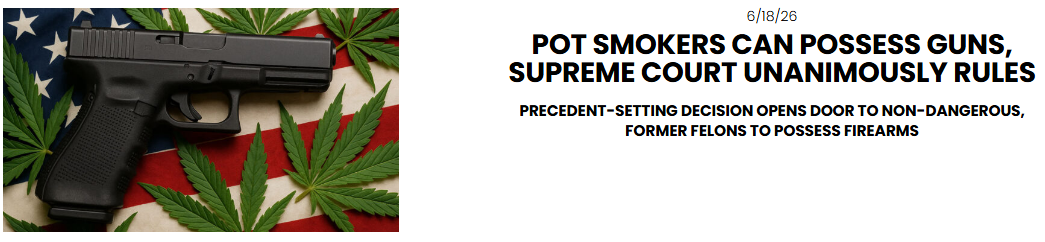
As previously reported by The Free Lance News June 18, the Court unanimously ruled in United States v Hemani that the criminal prosecution of a part-time marijuana smoker for unlawfully having a gun as a "drug user" violated the Second Amendment.
The unanimous majority in Hemani rejected 19th Century laws that disarmed vagrants as legitimate historical analogues that showed categorically disarming all drug users as a group was “consistent with the Nation’s historical tradition of firearm regulation."
Instead, only individual drug users may be disarmed, if the Government proves their addiction makes them dangerous or effectively incapacitates them.
The big takeaway from these two blockbuster decisions is that lawmakers can no longer disarm entire groups of Americans. Only individuals may be disarmed, on a case-by-case basis.
The Black Codes are finally dead—notwithstanding Liberals' wish for them to reach into the future from the grave.
For tips or corrections, The Free Lance can be reached at jasonbnicholas@gmail.com or, if you prefer, thefreelancenews@proton.me.