POT SMOKERS CAN POSSESS GUNS, SUPREME COURT UNANIMOUSLY RULES
PRECEDENT-SETTING DECISION OPENS DOOR TO NON-DANGEROUS, FORMER FELONS TO POSSESS FIREARMS
MALONE, NEW YORK JUNE 18, 2026
A unanimous Supreme Court delivered a stunning Second Amendment victory to marijuana users on Thursday.
While "drugs and guns can sometimes make for a dangerous mix," the Court declared, the "Second Amendment protects the right of 'all Americans' to keep and bear firearms for self-defense."
"All Americans" includes those like Ali Hemani, who, the Court wrote, "uses marijuana a few times a week."
At issue in United States v Hemani, No. 24-1234, was the constitutionality of a federal law making it a felony for a person who is “addicted to,” or an “unlawful user” of, a “controlled substance" to possess a gun. The Court held it was not. The unanimous opinion was written by Justice Neil Gorsuch.
Federal prosecutors charged Hemeni with violating the law, Section 924(a)(8) of Title 18 of the United States Code, in 2023. Citing the Supreme Court's 2022 decision in New York State Rifle & Pistol Assn., Inc. v Bruen, a federal district judge in Texas—where Hemeni was charged—dismissed the case. The Fifth Circuit Court of Appeals, which oversees Texas, upheld the dismissal. The Supreme Court agreed to hear the case last year.
Since the Supreme Court decided Bruen in 2022, courts faced with constitutional challenges to laws that restrict gun ownership must examine whether the challenged law is “consistent with the Nation’s historical tradition of firearm regulation.” If they are, they’re constitutional. If they’re not, the violate the Second Amendment and are illegal.
Before the Supreme Court, the US Attorney General argued § 924(a)(8)'s ban on firearm possession by drug addicts and unlawful users of drugs was “consistent with the Nation’s historical tradition of firearm regulation" because it was analogous to 19th century laws that allowed the disarmament of "habitual drunkards," vagrants and other "dangerous" people.
But the Supreme Court held "the habitual drunkard laws on which the government relies here differ dramatically from § 922(g)(3)’s unlawful user provision on every single metric the government invites us to consider."
"They targeted different kinds of people," the Court's opinion says, "did so for different purposes, and operated in different ways."
The first big difference between the two is historical habitual drunkard laws required proof the "drunkard" was indeed a "drunkard": that he was unable to keep a job and support his family. That he was, in effect, incapacitated. But § 924(g)(3) does not require any individualized proof that a particular person's drug use impaired their everyday function. Its a categorical, blanket ban that exposed violators to 15-year prison sentences and lifetime disarmament.
Not only that, but the Founders—the men who drafted the Constitution, including the Bill of Rights, and voted to make it the “Supreme law of the land,”drank regularly.
"John Adams took 'a tankard of hard cider' with his 'daily breakfast. Some say James Madison 'consumed a pint of whiskey daily,'” the Court's opinion points out, citing historical treatises for support. "There was, in short, a 'culture of copious drinking' in early America."
Not only did the Court rule that historical drunkard laws are not similar to § 924(g)(3) because the former required individualized proof of incapacitation, the Court also ruled they are not analogous because historical drunkard laws afforded alleged drunkards due process, while § 924(g)(3) does not afford drug users any due process.
“'Even when a law regulates arms-bearing for a permissible reason,'" the Court's June 18 opinion in Hemani states, “'it may not be compatible with the Second Amendment if it does so to an extent beyond what was done at the founding.'”
So even if § 924(g)(3) was motivated by a legitimate reason (to keep guns out of the hands of dangerous drug users), the Court ruled it violates the Second Amendment because it "automatically divests an individual of his constitutional right to bear arms the moment he becomes an unlawful user and until he ends his drug use—all without any pre-deprivation process."
Finally, the Court was troubled by the indiscriminate sweep of § 924(g)(3)—that presumed all drug users were inherently "dangerous." The Government "asks us to conclude that anyone who regularly uses marijuana is categorically violent and dangerous without any further showing. All based on little more than its current say-so," the Court’s opinion says.
That, according to the Court, would wrongly give Government "'broad power to designate any group as dangerous and thereby disqualify its members from having a gun.'“ That, in turn, “would risk allowing it to 'quickly swallow' the Second Amendment."
In reaching this conclusion, the Court's decision cites a famous 2019 dissenting opinion by current Justice Amy Coney Barrett before she was elevated to the Supreme Court in 2020.
In that dissent, Barrett argued a federal law disarming all felons violated the Second Amendment. Legislators only have the power to disarm "people who are dangerous. Founding-era legislatures did not strip felons of the right to bear arms simply because of their status as felons."
While the Court in Hemeni wrote in a footnote that “nothing in our opinion should be taken to cast doubt” on another federal law that disarms all felons, for life, those words are "dicta"—meaning, they're not essential to the Court's actual decision and hold no real legal power.
That dicta is also focused on the Government's power to disarm felons in the first place, upon their conviction. That is not the same legal question whether a felon's Second Amendment rights are restored upon the complete expiration of his or her sentence.
The actual holding in Hemani, which requires individualized consideration and proof that drug use by the particular person at issue makes that person dangerous, points decidedly in the other direction.
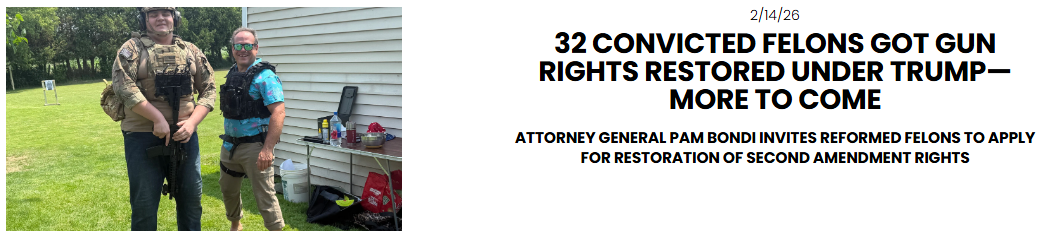
In other words, after Hemani, felons who have completed their sentences are entitled to the same individualized consideration as drug users are, including Government proof they are presently dangerous.
Justice Clarence Thomas joined the unanimous majority in Hemani, but also wrote a separate concurring opinion arguing that 18 USC §924(a)(8) was unconstitutional for an additional reason: it violated the Commerce Clause. If Justice Thomas is correct, then most federal firearm laws—including the one prohibiting felons from possessing firearms—are unconstitutional.
The case produced one of the oddest couples ever joined on the contemporary Supreme Court.
Justice Elena Kagan, a stalwart Liberal, signed on to a concurring opinion written by one of the Court’s most Conservative membes, Justice Samuel A. Alito Jr. Together, they explained why, in their view, 18 USC §924(a)(8) failed Second Amendment scrutiny: “the Government has failed to show that a marijuana user like respondent is incapacitated in a way analogous to the habitual drunkards that the Government’s analogues regulated.”
“Marijuana use today is like alcohol use at the founding,” Justice Alito wrote for the unlikely duo. “It is widespread and increasingly considered socially acceptable in many quarters. And from a practical standpoint, law enforcement widely tolerates the use of marijuana.”
Justice Kagen’s Liberal colleagues, Justices Ketanji Brown Jackson and Sonia Sotomayor, wrote a joint concurring opinion to argue that Bruen—the 2022 decision of the Court that now controls Second Amendment cases—was wrongly decided.
Instead of a historical tradition test, Justices Jackson and Sotomayor argued for application of a modern means-end test that weighs public safety against the individual right to keep and bear arms—a balancing contest Government usually wins.
But their opinion amounts to nothing more than wishful, and wistful, thinking. The Bruen historical tradition test controls now, and will for decades to come.
For tips or corrections, The Free Lance can be reached at jasonbnicholas@gmail.com or, if you prefer, thefreelancenews@proton.me.