HOW I SURVIVED BEING SWEPT OVER A WATERFALL
NOT BEING AFRAID TO TAKE EVEN LIFE-THREATENING RISKS AND THEN SAVING YOURSELF IF IT GOES SIDEWAYS IS ALWAYS SOMETHING TO TAKE PRIDE IN
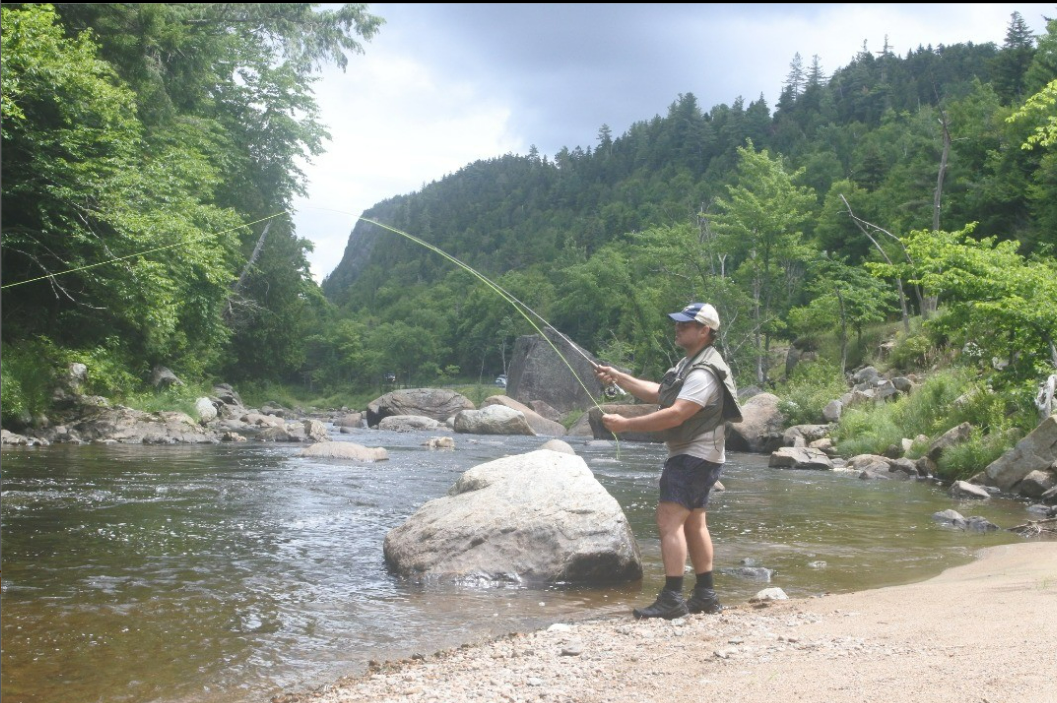
The author fly fishing on the East Branch of the Ausable River. Without waders.Photo credit: JB Nicholas.
MALONE, NEW YORK JUNE 15, 2026
I knew better than to try walking across the river above the waterfall, instead of below it, but it was a beautiful and broiling bright blue day. I'd already survived everything life had thrown at me, including bullets and knives, so I thought to myself "Why not? I wouldn't mind getting a little wet."
That including getting water into my chest-high waders, and maybe swimming underwater for a few feet.
I wasn't at the river that day to swim, but to fish. Since this perfect spot near the Vermont border in upstate New York was close to a road, it was a popular spot to do both. In my experience, that meant most of the fish that remained in the river, the ones that hadn't been caught yet, would be on the other side—where there was no road and far less people.
The river itself was wide. It rained a bit the day before. The water was a little high, a little fast and a little cloudy. I took my fishing gear off, except for the waders, and put all of it in the mid-sized backpack I carried my gear in whenever I had to hike into a place. My gear included a cylindrical, machined aluminum case that protected my $1000 Sage fly rod.
The far bank of the river was about 60 feet away. The water there was shallow, judging from the many rocks I could see that broke the surface. The deepest part of the river seemed right in front me, but I could only see about three feet down because of the silt in the water from the rain. About 10 feet away, I saw bottom, so I knew it was easily wadable—if I could get there. All I had to do was make it that 10 feet and I could stand up and cross. I was a strong swimmer and I felt zero fear.
I studied the water in front of me. The river bottom sloped up in solid bedrock to my left, downstream of the area I was about to step into. It can't be that deep, I thought to myself, as I stepped off the edge—and it was like a sky-diver taking their first step out of the plane. I never hit bottom. The current was stronger and faster than it seemed. I never had the chance to even try to swim. The river immediately carried me sideways.
By the time my head bobbed up back to the surface of the river, I was already going over the top of the waterfall.
Luckily, the waterfall wasn't the vertical variety, otherwise I would have been carried over a cliff.
This waterfall was the cascading, low-angled kind, with ramps, ledges and boulders every few feet. I banged into a few as I pin-balled down. I stayed calm and maneuvered my body so my feet pointed downriver. That way, they hit the rocks first, instead of my head. Still, each rock I banged into knocked the wind out of me. My head went under the water a few times. I popped back up, gasping for air and spitting out water. There was 30 or so feet of this.
I'd hiked past the bottom of the falls on my way in so I already knew what was waiting for me there: a lagoon-like pool about 100 feet across with a giant, counter-clockwise eddy. I didn't know exactly how deep it was, but however deep it was it was more than deep enough to kill me—probably 20 feet or more. I also knew however deadly all that deep water was, the deadliest part of that lagoon was right at the bottom falls, when I was about to get dumped.
White-water rafters call those spots "hydraulics."
Hydraulics can be lethal. Basically they're a whirlpool of death. When water flowing over a waterfall drops into a pool of still water it swirls around and around where it lands. If you're trapped in one, the only way to get out is to swim down, underneath the water, as close to the bottom as you dare, where its sucking power is weakest. There, push against whatever you find down there, and swim away from the whirlpool.
I had chest waders, boots and a backpack on. If I'd tried that I probably wouldn't have come up.
When you're caught in white water, don't try to stand up. Swim for the closest riverbank instead. If you try standing up, there's a real risk your foot will get caught in a crevice between rocks on the bottom. If that happens, you're dead because the water will drag your body past it, maybe snap your ankle or leg, then push you under as it goes over you—while your foot is still trapped.
But the closer I got to the bottom of the waterfall I was going over, the more I was convinced I should try to stand up and buy time—even if it was only a few seconds. I needed to catch my breath, see if there was any way to escape the hydraulic and formulate a rough plan. So that's what I did. As I neared the bottom, I pulled my feet together and pushed them down toward the riverbed.
Miraculously, I somehow stood up—at the very bottom of the waterfall. The hydraulic was literally thrashing at my feet.
I'd managed to catch the edge of a pothole—a vertical hole in solid bedrock beneath a waterfall that's been created by falling water over eons. They can be small or big, deep or shallow. This one was about three or four feet across. My feet caught the lip of it, otherwise I might have been pushed down into it by the force of the water. If that had happened, I'd be trapped and drowned inside it. If it was deep enough. Since this one was three or four feet across, it probably was.
Frozen there, panting, choking on water, fighting to get my breath, pushing ever so slightly forward so I wasn't dragged backward by the water and pushed down into the pothole, I scanned the lagoon in front of me. I searched for a rock or a floating tree branch or a beaver lodge—anything I could swim for and grab onto to keep myself from drowning.
All I saw was a light-colored patch in the middle of the lagoon under the dark water, about 50 feet out from where I was. I hoped it wasn’t a mirage. I hoped it was a sandbar—where sand carried by the river over the falls basically dropped out of the current in the slower water of the pool and piled up where it fell. Whatever it was, it was still far from the shore, but it was closer to me than the shore was. If I could make it there, I might be able to stand up—and live.
That was the good news. The bad news was my waders were filled with river water.
Like most wader-wearing fisherman, I'd worn a tight-fighting, elastic belt around my waist. Wading belts are supposed to keep water out of your waders if you submerge. That way, if you do end up in deep water over your head, you can float because the belt traps air below it—in both of your legs. (It was one of the reasons I wasn’t afraid to try crossing the river in the first place, even though I didn’t know how deep it was.)
But when my feet caught the edge of the pothole and I stood up, water coming off the falls jetted into the top of my waders, past the belt all the way down to my feet. In fact, it was the force of the water pushing down, into my waders, that was holding me in place. If I leaned forward, so the water was not shooting in, it would push me forward, off the waterfall, into the swirling hydraulic. That's why I had to balance, between two equally lethal possibilities.
Water-filled waders were just one of my problems.
The bigger problem was my boots. I might as well have been wearing cement shoes. Wading boots are designed to take a lot of abuse kicking rocks at the bottom of the river. They're very thick and heavy. I'd also double-knotted them to make sure they didn't come off. There was no way I could get them off without going under the water for probably something like half a minute while I fought to untie two knots. Then I'd have to do it again for the other boot.
The other big problem was I did not have the luxury of time. I couldn't stand there forever. It was a hot day, but the water was cold. Not ice cold but trout cold. It would only be a matter of time before my strength gave out. With every passing second I grew weaker. Not that anybody was coming to rescue me anyway. So I would have to act, and I would have to act fast—in seconds.
I thought about taking off the backpack I was wearing, with my fishing gear in it. If I took it off, there would be less weight pulling me down and less restriction on my movement as I tried to untie my boots. But the twisting and turning required would probably cause me to lose my balance and dump me in the hydraulic—or the pothole.
Plus there was thousands of dollars worth of gear in it. It wasn't just the fly rod that was valuable. Besides, if I had to take the backpack off in the lagoon, after I'd cleared the hydraulic, it would be easy. It wouldn't be like trying to untie double-knotted boots. So I kept my backpack on, bent my knees and sucked in as much oxygen as I could.
Then I jumped.
I jumped with as much explosive force as I could, over the hydraulic and out into the lagoon—away from the bottom of the waterfall. The hydraulic nipped at my feet, but my body cleared it. I tried to swim toward the shore. My boots and water-filled waders pulled me under, but I could overpower the downward drag and keep my head above water with a strong doggie-paddle. The problem was I was caught in the counter-clockwise eddy that flowed away from the closest shore and pulled me deeper into the lagoon. I was literally treading water—in one place.
I stopped paddling to see what would happen. My head sank below the water but I didn't go much further down. I couldn't figure out why, exactly, but the second time I let it happen I realized it was my backpack. Maybe it was an air bubble that miraculously formed inside, maybe a plastic component inside the pack itself or maybe it was the watertight aluminum canister my fly rod was in, or all three. Whatever it was in there that saved me, I rolled over and put my back on top of the pack, so I was face-up.
Suddenly I realized I was floating!
I tried kicking toward the shore, but the eddy was strong and it still held me in place. Plus I held back a bit because I was afraid of releasing the air bubble or whatever it was in my backpack that was giving me a fighting chance. Instead of risking losing that, I turned my body in the direction of the sandbar or whatever it was I'd glimpsed and kicked toward it. I couldn’t see it, but I’d clocked its location before I jumped and had a good sense where it was in relation to where I’d ended up. I didn't need to get to shore, all I needed was to get to that sandbar.
A minute later, I was standing on it. It wasn't a sandbar, exactly, that I'd found. It was more like a pillar or pinnacle of sand. Submerged under about two feet of water, about two or three feet wide, surrounded by dark, deep water. I'd never seen anything like it in decades of adventuring and haven't seen anything like it since. I’d seen plenty of sand bars but no sand pinnacles.
I stood up on the submerged sand pinnacle, in the middle of the lagoon, unlaced my boots and took off my waders.
Wonder of motherfucking wonders, here I was, I thought, still alive.
I looked around. I caught my breath. I relaxed a bit. I took it all in. I let it all out. I wasn’t out of the woods quite yet. It was important to not make another stupid mistake.
I took off my backpack. I took my time. I didn’t have to rush. Then I stuffed my boots and waders into it.
Finally, when I was good and ready, I stepped off the sand pillar and swam to shore semi-floating on top of the pack. With the waders and boots in it, it didn't really float—but it didn't exactly sink either. I kind of had to drag it through the water. It wasn't easy. But my life was no longer at risk. Only my fishing gear was. I’d ditch it in a second if I had to—then come back with a SCUBA suit and get it.
The swirling eddy tried to push me back. Without the boots and flooded waders dragging me down, I overcame the current. Still, by the time I crawled out of the water onto a small sand beach two or three long minutes or so later, dragging my backpack behind me, I was exhausted. I laid on the sand, stared up at the blue sky and watched the wind flutter the green leaves on the branches of the tall trees towering above me.
After a few moments, I cracked a hard-earned smile and let out a small, satisfying laugh. I'd cheated certain death—yet again.
Yeah I'd fucked up, it was my fault for letting myself get sucked over the waterfall in the first place, but I stayed cooler than ice and saved myself. Not being afraid to take even life-threatening risks and then saving yourself if it goes sideways is always something to take pride in. Shame is doing nothing with your life but staying home, staring at your phone and not risking anything.
I own my life, in full. So should you.
For tips or corrections, The Free Lance can be reached at jasonbnicholas@gmail.com or, if you prefer, thefreelancenews@proton.me.