ROBERT BROOKS MURDER-BY-PRISON-GUARDS CASE ENDS (ALMOST) WITH A BANG; GOV. KATHY HOCHUL SIGNS FAKE PRISON 'REFORM' BILL
FORMER GUARD DAVID KINGSLEY GETS MAXIMUM 25-YEARS-TO-LIFE SENTENCE. ONLY ONE TO APOLOGIZE FOR THE KILLING

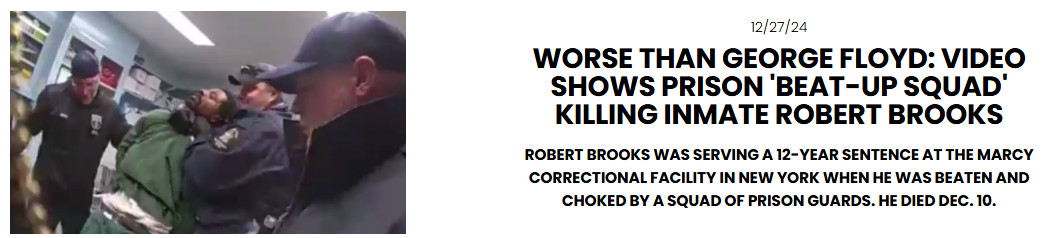
Prison guards murdering Robert Brooks at the Marcy Correctional Facilty, Dec. 9, 2024. Photo credit: bodycamera from the New York State Department of Corrections and Community Supervision via New York State Attorney General Letitia James.
UTICA, NEW YORK Dec. 20, 2025
David J. Kingsley III, a former New York State prison guard caught on camera choking and restraining Robert Brooks while he was beaten to death by a group of guards at the Marcy Correctional Facility last December, has been sentenced to 25 years-to-life.
Oneida County Court Judge Robert Bauer, who presided over Kingsley's October jury trial which ended in his convictions for second degree murder and first degree manslaughter, delivered the maximum sentence ice cold, without bothering to address the convicted murderer directly.
Out of the nine guards who were convicted so far for killing Brooks or attempting to cover up his killing, Kingsley received the longest sentence.
Kingsley was led into court by officers wearing an orange prison uniform. He was shackled and wearing a black bullet-proof vest. He stood with head down beside his defense lawyer, Luke Nebush, chief trial counsel for the Oneida County Public Defenders, as prosecutors then Brooks' family members spoke.
Robert Brooks Jr., the murdered man's son, told the Court watching the horrific video capturing his father's murder made him feel like he was "stuck in a horror movie and you guys were the monsters. I felt broken and there was nothing I could do."
He asked judge Bauer to impose "a sentence severe enough to tell correctional officers that they cannot treat incarcerated people like animals."
"And I pray that this court," Brooks concluded, "imposes a sentence severe enough to tell incarcerated people that their lives matter."
Jared Ricks, Robert Brooks' brother, also spoke. While Brooks Jr. has spoken at the sentencing of other guards, Ricks has not.
"I ask that Mr. Kingsley receive a sentence that fits his key role in my brother's brutal killing," Ricks said.
"My brother used to say, 'To err is human, to forgive is divine,'" Ricks added. "For us, forgiveness will take a long road."


When judge Bauer asked Kingsley if he had anything to say before the court sentenced him, Kingsley said he did and became the only guard convicted of killing Brooks to apologize.
"I would like to offer my heartfelt apologies to the Brooks family," Kinglsey said. "And words cannot express how truly saddened and heartbroken I am that I was involved in such a tragic event that took someone's loved one from them."
"All of the events that happened over the last three days of Mr. Brooks' life should never have happened," Kingsley added. "Every single incident was senseless."
By referring to "all of the events that happened over the last three days of Mr. Brooks' life," Kingsley was including the two beatings Brooks suffered by gang members at the orders of guard Sherri Abreu at the Mohawk Correctional Facility.
The beatings triggered Brooks' transfer to Marcy, where he was killed by a gang of guards including Kingsley less than an hour after his arrival.
The Free Lance reported exclusively on Thursday Abreu was the guard who ordered those beatings, and also reported exclusively that Abreu is still working at Mohawk.
Kingsley's sentencing largely wraps up a case that started when Brooks, who was black and handcuffed, was beaten and choked to death by the gang of all-white guards at Marcy Dec. 9. Brooks was in-and-out of consciousness during the attack, which was tantamount to torture.
"Beat-up squads" of guards have for decades operated largely with impunity in New York's prisons. The beat-up squad at Marcy that murdered Brooks is no exception. Attorney General Letitia James ignored the Marcy squad, even though her office was warned of its existence in 2023 by another prisoner, William Alvarez, The Free Lance exclusively reported days after Brooks' murder.
Nurses who worked in Marcy's infirmary, where the beat-up squad regularly took prisoners to abuse because it lacked security cameras, also covered up the abuse of prisoners there for years, The Free Lance also exclusively reported.

Instead of putting a stop to the prison guard crime wave, Attorney General James built a national profile with politically-motivated partisan lawsuits against the NRA and Donald Trump, while the gang terrorized a prison full of black and hispanic inmates, regularly beating them for sport.
A total of 9 guards including Kingsley have now been convicted for killing Brooks or attempting to cover the murder up. Two, Nicholas Kieffer and Mathew Galliher, were acquitted at the same trial Kingsley was convicted at.
Of those 9, Anthony Farina and Nicholas Anzalone received 22 years in prison after pleading guilty to first degree manslaughter. Christopher Walrath, who threw the first punches, also pleaded guilty to manslaughter. He was sentenced to 15 years.
Sgt. Michael Mashaw and David Walters also pleaded guilty to manslaughter. They were sentenced to 3-to-9 and 2 1/3-to-7 years, respectively. Walters, however, was released on bail pending appeal in a shocking decision made by a St. Lawrence County judge Dec. 10.
Sgt. Glenn Trombly and another guard, Robert Kessler, testified for the prosecution at the trial of Kingsley, Kieffer and Galliher. Kessler pleaded guilty to gang assault and was promised a sentence between 5-7 years in exchange for his testimony. Trombly pleaded guilty to attempted gang assault and was promised a 4-year sentence.
A third guard whose name is not known with certainty agreed to help prosecutors and pleaded guilty to unknown charges in exchange for specific sentences also not known at this time. Fitzpatrick said he would disclose the charges and the sentences in the future.
Yet another guard, Nicholas Gentile, was charged with evidence tampering. He pleaded guilty to a misdemeanor charge of attempted evidence tampering and was sentenced to one year conditional discharge and a $250 fine, the Rome Sentinel reported.
That leaves guard Michael Fisher, who was also present when Brooks was murdered and failed to stop it. He is scheduled to go on trial before judge Bauer Jan. 12.
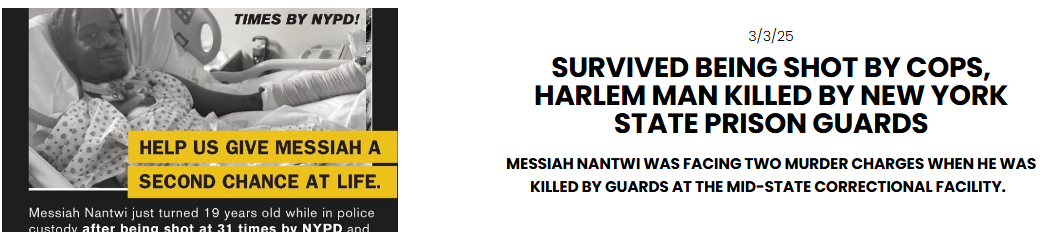
Less than three months after Brooks was killed at Marcy, guards at another state prison across the road from Marcy, Mid-State, killed another black prisoner, Messiah Nantwi. 16 guards were charged in connection with that killing. Six have pleaded guilty and the remainder will go on trial in March.
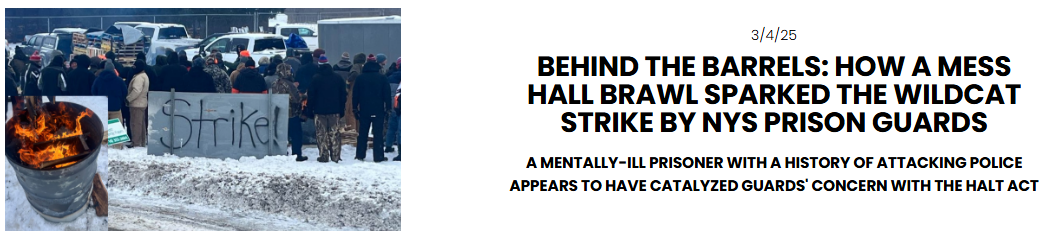
Nantwi's killing took place on the 15th day of a state-wide wildcat strike by prison guards. The strike ended with the firing of about 2,000 guards on the strike's 22d day and their replacement by National Guard soldiers—who have been deployed in New York's prisons since.
The shortage of guards set in motion a slow-burning crisis that continues to this day.
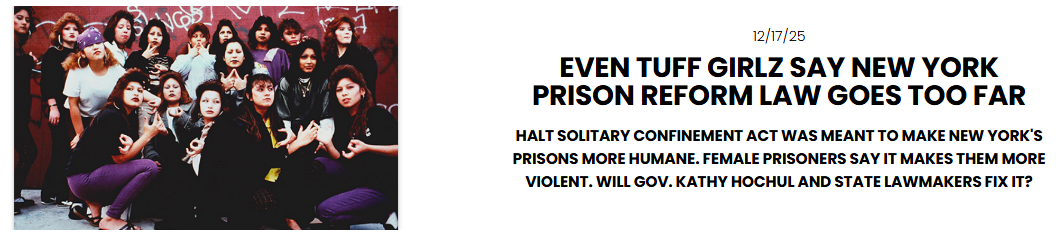
In addition to increased violence, prisoners' access to visits, rehabilitative programs, recreation and almost everything else that makes prison life bearable has been restricted, increasing tensions behind the walls even more. The on-going crisis threatens to explode in a riot or take-over at any moment—like it did at Attica in 1971 or Bedford Hills in 1974.
The killings of Brooks and Nantwi unleashed a groundswell of popular activism by New Yorkers aimed at reforming the state's prison system to ensure what happened to Brooks and Nantwi doesn't happen to any other prisoner ever again. That movement is led by formerly-incarcerated New Yorkers.
The coalition made recommendations for easing the crisis that focused on reducing the total number of people in New York's prisons by increasing opportunities for early release, thus lowering New York's overall prison population.
Instead of adopting these recommendations, the state legislature passed a weak slate of bullshit it called "reforms" intended to increase independent oversight of the state prison system labeled the Jail and Prison Oversight Omnibus Bill. None of the measures address the core issues that have increased violence by both guards and prisoners in the state prison system.
After the legislature passed the Omnibus bill in June, it let it sit around for months while the crisis in New York’s prisons deepened until last week. That’s when the legislature finally sent the bill to Gov. Hochul for her signature to make them law.
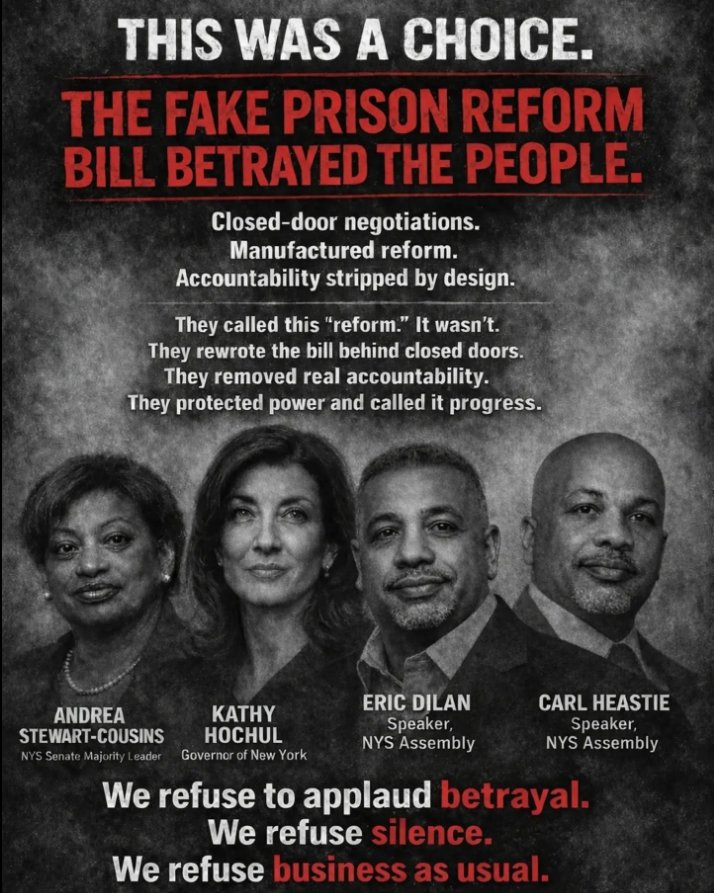
On Friday, Gov. Hochul called Robert Brooks jr. and told him she intended to sign the bills. She publicly announced the signings in a news release Friday afternoon.
“Every single individual who enters our prisons deserves to be safe, whether they are employed there or serving their time,” Gov. Hochul said. “In the year since the murder of Robert Brooks, we have implemented a number of new policies and initiatives to begin the process of reforming our corrections system.”
She said those included "expediting the installation and use of fixed and body worn cameras, making it law that body worn cameras must be worn and turned on, and investing more money in the Office of Special Investigations."
Friday evening, Robert Brooks jr. said "We did it" and "thank you to everyone contributing" in a video published on Facebook.
Referring to judge Bauer's sentencing of Kingsley to the maximum prison time allowed by law, Brooks said "hearing him say 25-years-to-life I started shedding tears. Not because I felt bad for him."
"But," Brooks explained, because "all this could have been avoided if one person, one single person, would've just said ‘You'all doing too much. You'all need to stop.’"
"If one person woulda did that," Brooks concluded, "my dad would be alive and none of this would have to be going on."
Brooks ended by saying "Got some big things coming up soon." Referring to the fake "reform" bills Gov. Hochul signed on Friday, Brooks said "that's just the start."
Send tips or corrections to jasonbnicholas@gmail.com or, if you prefer, thefreelancenews@proton.me