‘EXTREMELY DISTURBING’: GUARD WHO ADMITTED KILLING ROBERT BROOKS GRANTED BAIL PENDING APPEAL
DECISION CALLS INTO QUESTION GUILTY PLEAS OF OTHER DEFENDANTS IN THE ROBERT BROOKS AND MESSIAH NANTWI CASES
Former state prison guard David L. Walters being taken to prison after pleading guilty to manslaughter for killing Robert Brooks. Photo credit: JB Nicholas.
MALONE, NEW YORK Dec. 10, 2025 Last updated: 10:17 PM
One of the prison guards who pleaded guilty to killing Robert Brooks was gifted an early Christmas present when a State Supreme Court justice in Watertown granted him bail pending appeal on Wednesday.
David L. Walters was expected to be released as early as Wednesday evening after Justice James P. McClusky granted his request for release on bail pending appeal in a decision published Wednesday afternoon.
Justice McClusky set Walters’ bail at $50,000 cash or $100,000 bond.
The decision was first reported by WKTV 2 in Utica.
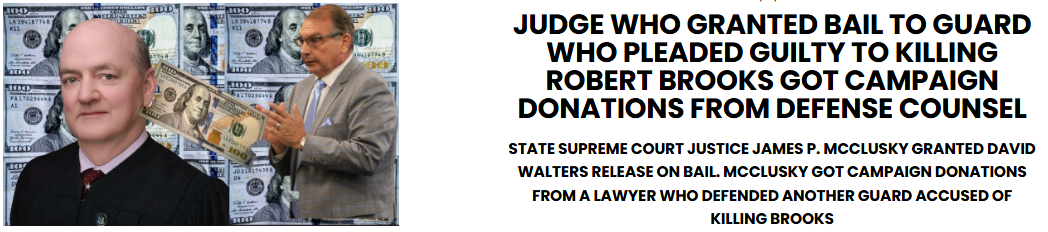
David A. Longeretta, the primary lawyer for another one of the prison guards accused of killing Robert Brooks, gave Justice McClusky $250 in campaign cash this past May for the judge’s successful re-election bid in November, public records show.
"Extremely disturbing" is what the special prosecutor in the Brooks case, Onondaga County District Attorney William F. Fitzpatrick, called the decision in an electronic message to The Free Lance Wednesday evening.
Fitzpatrick added "an Appellate Division judge already denied the application of another defendant on the same issue."
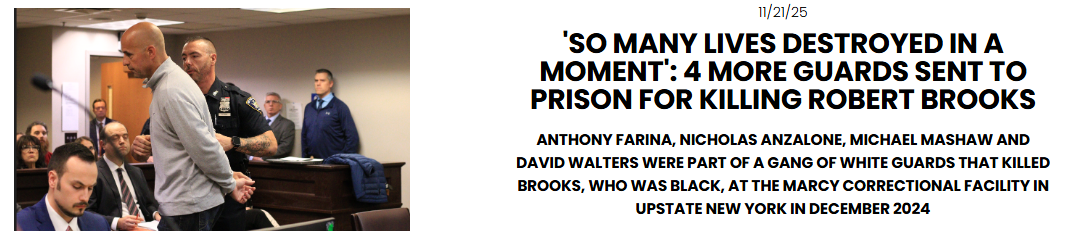
That was former sergeant Michael Mashaw, Fitzpatrick said. Mashaw was sentenced beside Walters on Nov. 21. He remains in state prison, serving his sentence.
Fitzpatrick's office secured their guilty pleas to manslaughter and opposed their applications for bail pending appeal.
Nicholas A. Passalacqua, Walters' lawyer, smartly exploited a quirk in the law to get his client's appeal bail application to a Republican judge in one of New York's most rural and conservative counties.
Justice McClusky became nationally infamous in 2019 when he sentenced a 26-year-old man who raped a 14-year-old girl to probation instead of prison. He’s also lucky. McClusky was the sole Republican to hold off a Democratic onslaught in the Fifth Judicial District to win re-election to a second 14-year term in November.
While most convicted defendants ask the appellate division to consider requests for release on bail pending appeal, Passalacqua applied to a judge in Watertown because § 460.50(2)(b)(ii) of New York's Criminal Procedure Law allows these applications to be made to "a justice of the supreme court of the judicial district embracing the county in which the judgment was entered."
Oneida County, where Walters pleaded guilty, and Jefferson County, where Justice McCluskey is based, are both part of New York's Fifth Judicial District.
Walters' bail application centers on whether what he pleaded guilty to is actually a crime.
While manslaughter is clearly a crime, Passalacqua argued that what Walters specifically admitted to was not a crime. Walters admitted "having a duty to intervene" and failing to stop Brooks' murder.
According to Walters, although he admitted he had a "duty to intervene," he didn't actually have a legally enforceable "duty" to stop his fellow Correction Officers from killing a prisoner in their custody—even though he swore an oath to follow the US Constitution, which specifically prohibits both executing prisoners without a trial and inflicting cruel and unusual punishment on them.
Justice McClusky's decision implies Walters is right and the Constitution is meaningless—or at least that his argument is so strong he has at least a 50/50 chance of winning his appeal.
But even if Walters is right and he did not have a legal duty to intervene and stop Brooks’ murder, that's what the law calls “harmless error” because there's an additional and independent factual basis to sustain Walter's manslaughter conviction.
Walters' argument and Justice McClusky's decision ignores that Walters also admitted—and video shows (video above starting at the 4 minute mark)—he "verbally instructed" a nurse who "attempted to enter the emergency room to attend to Mr. Brooks" while he was being killed to "not to enter the emergency room."
That nurse could have saved Brooks’ life, if he’d been allowed to do his job.
So even if Walters did not have a legal duty to intervene to stop other guards from killing Brooks, his admission he stopped a nurse from aiding Brooks is enough in itself to make him guilty of manslaughter.
Fitzpatrick, the special prosecutor, said late Wednesday night his office was "checking" to see if it could appeal McClusky's decision.
Send tips or corrections to jasonbnicholas@gmail.com or, if you prefer, thefreelancenews@proton.me