DID A SERIAL SHOE-LACE KILLER LEAVE 2 DEAD INSIDE NEW YORK'S PRISONS?
EVAN COLVIN WAS FOUND DEAD BY A SHOELACE IN A CELL HE SHARED WITH ANDREW HERNANDEZ IN 2024. HERNANDEZ CONFESSED, BUT WAS NEVER CHARGED. 2 YEARS LATER, HERNANDEZ KILLED MICHAEL CAMPBELL IN THE CELL THEY SHARED—WITH A SHOELACE

Evan Colvin, 27, was founding hanging by a shoelace in a disciplinary segregation cell he shared with Andrew Hernandez in 2024. Hernandez confessed to strangling Colvin but was not charged. Two years later, Hernandez strangled Michael Campbell to death with a shoestring in a disciplinary segegation cell at another prison in 2026. This time, he was sentenced to life without parole. Last week, police reopened the investigation into Colvin’s death. The case raises questions about New York’s practice of putting two prisoners who have violated prison rules, sometimes violently, in the same cell. The 2022 HALT Act was supposed to make disciplinary segregation more humane, but failed to stop double-celling. Photo credit: Evan Colvin via James McAlister.
MALONE, NEW YORK Oct. 25, 2026
A New York State prisoner already serving life for murdering his mother in 2001, who admitted murdering a cell-mate by strangling him with a shoe-lace earlier this year, may have killed another cell-mate two years ago—also with a shoe-lace.
"'If anything happens to me, look into my bunkie,'" Evan Colvin told his brother Joshua Bartell on Feb. 18, 2024, Bartell told The Free Lance News.
The 27-year-old Colvin was found hanging dead by a shoelace two days later—in the cell he shared with Andrew Hernandez, then 39. The shoelace that killed Colvin was tied to the top of the double bunk-bed he and Hernandez both slept on, Colvin's autopsy report shows.
Hernandez confessed to killing Colvin, the report also shows.
The Free Lance News obtained part of the report from Bartell and another one of Colvin’s brothers, James McAlister.
Colvin and Hernandez were inside that cell together in 2024 because they’d both violated prison rules and were punished for it by being sent to a segregated disciplinary housing unit at the Collins Correctional Facility, outside Buffalo. Double-celling is the norm in disciplinary segregation in New York. Prisoners in general population are not generally double-celled.
Ultimately, Hernandez wasn't prosecuted for killing Colvin because he changed his story and claimed Colvin hung himself instead.
"They listed his death as a suicide. That isn't the case," McAlister, 35, said. "The real cause of death was murder. Murder by his bunkie."
Two years after Colvin was found dead in a disciplinary segregation cell with Hernandez at Collins, Michael Campbell was found dead in another disciplinary segregation cell with Hernandez in another disciplinary segregation cell, this one in an Adirondack prison, last April.
The 51-year-old Campbell was strangled with a shoelace.
Franklin County District Attorney Elizabeth Crawford successfully prosecuted Hernandez for first degree murder—a rare charge reserved for cop killers and prisoners who kill, among others.
Now, both the State Police and prosecutors have re-opened their investigation into Colvin's 2024 death at Collins.
"Our office is currently investigating the death of Evan Colvin," Kaitlyn A. Munro, Director of Public Relations and Communications for Erie County District Attorney Michael J. Keane, confirmed in an email message Friday afternoon.
The deaths of Colvin and Campbell raise significant questions about the safety of the state's practice of confining prisoners who've broken prison rules—many times with bloody violence—in the same cell as punishment. Sometimes even members of warring gangs are placed inside the same cell.
Relatedly, their deaths also spotlight a 2022 law intended to make disciplinary segregation more humane. The HALT Act failed to ban double-celling.
Kelly Northrup, Campbell's sister, said officials told her Hernandez said he killed her brother because "'I needed to show New York I wasn't playing.'"
Northrup explained Hernandez told officers "if they forced him to go into a cell with someone he would kill them and it just happened to be my brother."
"My brother," she added, "was murdered for simply than no other reason than Hernandez wanted to be in a cell by himself."
Hernandez, now 43, was an 18-year-old high school senior when he woke up one morning and killed his mother, Janice, 43, inside the Guilderland, New York home they shared in 2001. He shot her once in the back of the head with a .22 caliber rifle. She was working at a computer in her home office when Hernandez did it.
After killing his mother, Hernandez walked into the local police station and confessed to doing "something bad," the Altamont Enterprise reported. Terence Kindron, Hernandez's lawyer at the time, initially said he planned to mount an insanity defense, but his client pled guilty to second degree murder. Hernandez was sentenced to 19 1/2-years-to-life in prison in 2002.
A decade later, Guilderland voters were preparing to decide whether to approve an $18 million bond issue. The money was for improvements to the town's schools, including security upgrades. That's when Guilderland police officer Nick Ingle claimed, for the first time, Hernandez intended to shoot up the high school, the Altamont Enterprise also reported.
Ingle told the School Board during a public meeting in 2013 Hernandez had “written out a plan.” He was going to take guns, wrapped in an American flag, into the school, take a girl hostage, use her “as a human shield” and “shoot first responders.” Before that, Ingle alleged, Hernandez "decided to test himself” by shooting his mother.
“He said, if he could kill his own mother, he could kill people he didn’t care about,” Ingle added.
Flash-forward to February 2023.
Hernandez was first considered for parole in April 2021 and denied. He was scheduled to be reconsidered in April 2023.
It's not presently known what Hernandez did that violated prison rules, or when he did it, but he was segregated from the general population in a disciplinary unit at Collins in February 2023. The unit is a jail-within-a-jail, built to confine the worst-of-the-worst, under the most-restrictive conditions possible. Cells in the unit were built to hold two.
John Moore is a social media influencer who helped publicize Hernandez's suspected murder of Colvin. He also served 32 years in the prisons of New York and Connecticut, from 1989 to 2020.
"New York don't give a fuck. Albany don't care. They'll put you in a cell and tell you 'kill yourselves,'" Moore charged. "They shouldn't be double-bunking guys."
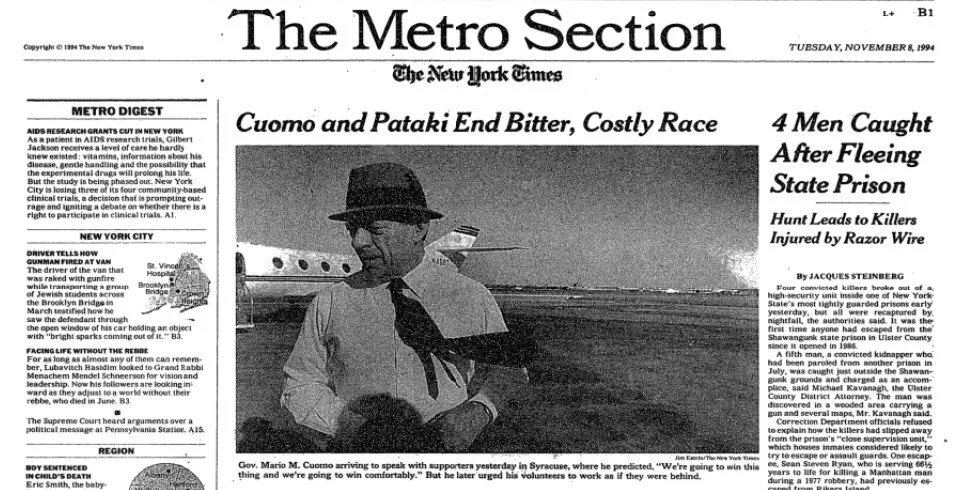
Moore said the problem dates back 31 years to when a peanut farmer from Peekskill beat Mario Cuomo to become New York's 53d governor in 1995.
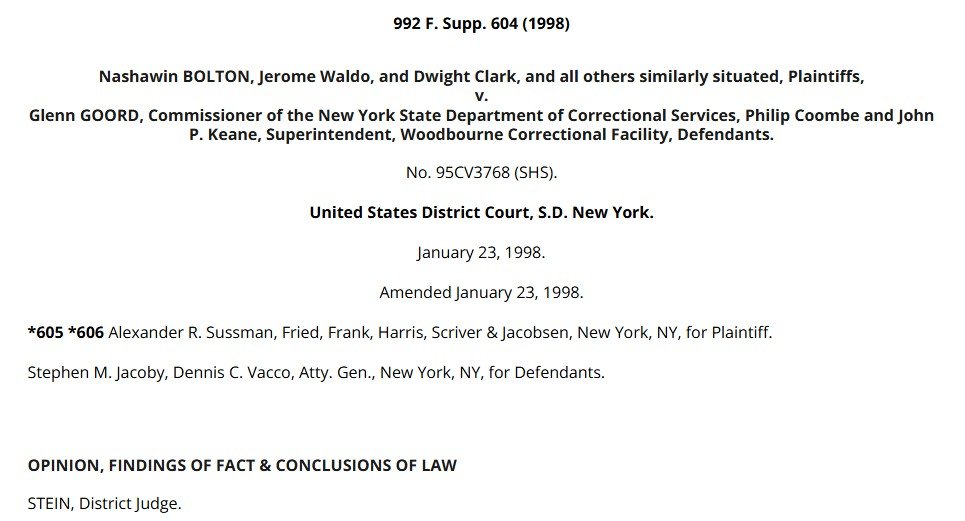
When Gov. George Pataki first ordered double-celling of general confinement prisoners in 1995, a group of them sued in Federal court under the Eighth Amendment to block it. Among other things, the plaintiffs in Bolton v Goord argued the risk of violence was too high to be humane.
In other words, someone was going to be killed because of it, sooner or later.
The guards' union, the New York State Correctional Officers & Police Benevolent Association, agreed. They opposed double-celling—a position they maintain to this day.
Manhattan judge Sidney H. Stein, nominated by Pres. Bill Clinton and confirmed by the Democrat-controlled US Senate in 1995, dismissed the lawsuit. He wrote "Plaintiffs failed to establish ... risk of future physical harm arising from violence among double-celled inmates."
Judge Stein's 1998 ruling was, in effect, a green-light to expand double-celling however Gov. Pataki and the state legislature wished. They expanded it to disciplinary segregation, where risk of violence is substantially greater.
"We're talking about the craziest people in the population," prison reform advocate and paralegal Michelle Bonet told The Free Lance News. "Putting two of them together in the same cell was always a bad and dangerous idea. Somebody dying was always foreseeable."
Bonet knows what she's talking about. She spent 7 years in a New York state prison before she was paroled.
"Even the Union agrees double-celling has to end," Bonet added. "I never thought I'd agree with them but on this I do."
Back in 1998, Gov. Pataki asked the legislature to fund construction of 8 100-cell, 200-bed disciplinary segregation units with cells specially designed to hold two prisoners for weeks, months or years on the grounds of existing prisons around the state. Each one was a "SHU-200" or “S-Block.”
Lawmakers funded them plus construction of an entirely new "supermax" disciplinary prison with about 750 double-cells for 1,500 hardcore criminals who couldn't behave themselves in a regular prison. When the legislature tried to force the governor to add space for rehabilitation programs, Pataki blocked it.
Democratic state lawmakers sued the Republican governor. The fight ended up in New York's highest court. The Court of Appeals’ 2001 decision in the case, Silver v Pataki, rubber-stamped Pataki's powerplay and forever expanded the governor's leverage over state budget negotiations. Legislators still moan about it.
It was years before the wave of reform driven by the Black Lives Matter movement rose high enough to reach prisons, but after the 2020 police murder of George Floyd in Minnesota state lawmakers finally enacted some. One prison reform the state legislature passed was the Humane Alternatives to Solitary Confinement Act. Gov. Kathy Hochul signed it into law in 2022.
The HALT Act was intended to make disciplinary segregation more humane. One thing the HALT Act did not do was eliminate double-celling.
Colvin "lived life the fast way," McAlister, one of his brothers, revealed.
"That's all he knew was selling drugs and hustlin'," he explained. "He just took to it like a rockstar."
Colvin grew up surrounded by farmland in the Central New York town of Morrisville, near Colgate. Instead of learning one of the lawful trades taught at the SUNY college there, he dealt drugs throughout the Mohawk Valley and beyond, McAlister said. "Madison, Rome, Utica, Syracuse, Herkimer."
"There's a lot of shit that that boy did," McAlister candidly admitted. "Karma was going to be very bad to that boy eventually."
Then 23, Colvin was arrested for criminal possession of a weapon and stolen property on Sept. 11, 2020. He pleaded guilty to attempted criminal possession of a weapon and was sentenced to two years in state prison in 2021.
He was paroled in the Spring of 2022, but re-arrested two months later. Police stopped the 2021 Toyota Camry he was riding in to arrest his girlfriend, Diane Clark, 38, becase there was a warrant out for her.
"Upon conducting the vehicle and traffic stop on Clark’s vehicle, Investigators developed probable cause for a search," Madison County Sheriff Todd M. Hood said in a July 19, 2022 news release.
The search "yielded a quantity of methamphetamine, suspected MDMA, psilocybin mushrooms, heroin, Suboxone, marihuana [sic], drug packaging materials, scales, metal knuckles and"—as an added bonus—"a loaded Ruger 9mm semi-automatic handgun."
Cops hit the lottery. Colvin pleaded guilty, again. He was sent back to prison with an additional three-to-six year sentence.
He ended up at the Mohawk Correctional Facility, outside Rome—the center of the region he'd been dealing drugs in.
Oral argument in Silver v Pataki where Democrats in the state legislature sued Republican Gov. George Pataki after Pataki rejected their attempt to make him add space for rehabilitation programs inside a new “supermax” disciplinary prison they agreed to build in the Adirondacks. Andrew Hernandez murdered Michael Campbell in a cell there Apr. 6, 2026.
Bartell stayed in touch with his brother.
"I sent him commissary money, sent him stamps, answer the phone when he called," he said.
By the winter of 2024, Colvin "and his girlfriend were being extorted" at Mohawk, Bartell revealed. That's why Colvin was sent to Collins and put in a cell with Hernandez, on Feb. 14, according to Bartell. He said he spoke on the phone with his brother soon after.
"'Well come and see me, it's my birthday,'" Bartell said Colvin asked. "He was all excited."
Bartell visited Feb. 18, the day after his brother’s birthday.
"We give hugs and then he explains the stuff that happened at Mohawk," Bartell said.
Since he himself had been to prison, he asked Colvin "how his bunkie is?"
"'Fucking weird,'" Colvin answered, according to Bartell. "'He talks to himself. He walks back-and-forth.'"
That's when his brother told him if anything happened to him it was his bunkie.
Bartell said Colvin also told him, "'His last name is Hernandez and his first initial I think is 'A'. He has an old number and he's in here for murder.'"
But then they "just laughed it off." They started "talking about future plans."
Two days later, guards found Colvin dead inside the cell with Hernandez. It was only then that Bartell discovered who A. Hernandez was.
"Hernandez told everybody he killed Colvin," a Correction Officer who worked at Collins when Colvin was killed there told The Free Lance News on Friday. "He told the COs, the sergeant, the lieutenant, the captain, everybody."
Their identity is known to The Free Lance News. They requested anonymity because they may return to work there.
The former Collins officer said even the prison doctor thought it wasn't suicide.
"'That's no suicide ligature,'" they quoted the doctor, Dr. Ken Jin, saying.
Reached by telephone on Saturday, Dr. Jin did not deny that's what he said.
Dr. Jin did say he still worked for the state prison system and therefore could not comment.
"It's gonna get me in trouble if I say anything," he explained.
The former Collins officer said that after Hernandez told "everybody" he did it, "Albany OSI pulled him into a room and he comes out saying it was a 'suicide.'“
"Everyone was like, 'What the fuck just happened?!,'" they added. "We just saw them cover up a body."
OSI stands for the Office of Special Investigations, a unit inside DOCCS that investigates crimes inside state prisons—and sometimes covers them up, according to critics, like former Superintendent Albert Montegari.
Dr. Tara Mahar, the Erie County Medical Examiner, determined Colvin hung himself. In her autopsy report, Dr. Mahar explained away Hernandez's confessions. She wrote they included "numerous incongruities."
Dr. Mahar did not respond to an invitation, emailed to her office early Friday morning, to state whether Hernandez's subsequent murder of Campbell changes her opinion that Colvin's death was a suicide.
A double-cell inside disciplinary segregation at the Upstate Correctional Facility.
After Colvin's death at Collins in 2024, state prison officials shipped Hernandez to the Upstate Correctional Facility—a disciplinary prison on the Canadian frontier outside of Malone.
Upstate was the double-cell "supermax" at the center of the power struggle between the state legislature and Gov. Pataki at the start of the 21st Century.
A former Correction Officer who worked at Upstate confirmed Hernandez was kept alone in a double-cell there.
"It was well-known he shouldn't have gone in a cell with anybody," they said. "Everyone was aware of that because of what happened at Collins."
This former officer's identity is known to The Free Lance News. They requested anonymity because they may return to work there.
They explained that some of Upstate's double-cells are designated to be used only as single cells. That's because doctors and officials in DOCCS' Central Office in Albany can order a prisoner housed in only a single-cell.
Hernandez was kept in a single-cell at Upstate until early April 2026, the officer said. That's when DOCCS' central Albany office ordered Hernandez placed in a double-cell with someone else.
Local officials at Upstate objected and "documented it all the way to the top," the former officer said.
Campbell, 51, was found dead "under a sheet" inside the cell Apr. 6, the State Police said in an April 13 news release.
"Further investigation," the news release said, "revealed signs of foul play, indicating that Campbell had been strangled with a shoelace by his cellmate, Andrew Hernandez, age 42."
Northrup, Campbell's sister, said Upstate officers told her after her brother's killing they "made repeated requests for Hernandez to not be housed with anyone else and they were ordered to put Hernandez in that cell with my brother."
Neither Northrup nor the former Upstate officer know who in DOCCS' Albany Central Office ordered Hernandez placed in a double-cell.
It's possible it was the DOCCS' Commissioner himself, Daniel F. Martuscello, III, given Colvin's death in Hernandez's cell at Collins.
If it wasn't, according to public records, it likely involved Ann Marie McGrath, DOCCS' Deputy Commissioner of Strategic Planning and Population Management; Jennifer L. Kotzur, Director of Classification and Movement; and Stacey Fredenburgh, coordinator of prisoner "movement."
Kotzur and Fredenburgh did not return voicemails left on their mobile telephones for comment. Attempts to reach McGrath were not successful.
A spokesperson for DOCCS' did not respond to multiple questions about Hernandez, Colvin's death or Campbell's murder—including who decided to put Hernandez in a cell with Campbell at Upstate and whether they were disciplined administratively.
No DOCCS employee was criminally prosecuted for putting Hernandez in a cell with Campbell.
Crawford, the Franklin County District Attorney, declined to comment.

Report published about the Upstate Correctional Facility in the April 2003 issue of DOCS|TODAY.
Christopher C. Campbell, Mike Cambell's brother, blamed the HALT Act for failing to stop double-celling.
"It's our governor's fault that this happened," Campbell said. "It's Hochul's fault for putting in the HALT Act."
McAlister, Colvin's brother, agreed "This could have been prevented."
"If they would have did everything the right way when he [Hernandez] killed my brother," McAlister said, "that guy [Campbell] would be alive."
Hernandez refused a plea-bargain of 20-years-to-life at his arraignment for Campbell's murder in Franklin County Court last June. He asked for life in prison and was sentenced to life in prison without parole by Franklin County Judge Craig Carriero last Monday.
"I'm not the only one handing out a life sentence," Judge Carriero told Hernandez, mentioning Campbell's mother and sister, who were in the courtroom. "You sentenced them to a life without their son and their brother."
Joan Scotchmer, Campbell's mother, carried an urn into the courtroom. When it was her turn to speak, she stood, cradled the urn in her arms and faced Judge Carriero.
"This is my son Michael," she said, as if introducing him. "All he wanted was to come home and have a mom hug."
Turning to face Hernandez seated steps away at the defense table beside his lawyer, she added, "And it was taken from me."
Hernandez stared blankly at her as she spoke.
"I can no longer hug my son," Scotchmer added, gesturing to the ash-filled urn in her arms, "Only this."
Hernandez is currently incarcerated at the maximum-security Auburn Correctional Facility. Someone familiar with his confinement there said he was housed in a single cell.
Send tips or corrections to jasonbnicholas@gmail.com or, if you prefer, thefreelancenews@proton.me