HALF-MILLION DOLLAR VERDICT AFFIRMED AGAINST GOV. KATHY HOCHUL'S HAND-PICKED PRISON CHIEF DANIEL F. MARTUSCELLO III FOR SILENCING CRITIC
STATE PRISON BRASS RETALIATED AGAINST WHISTLEBLOWER FOR PUSHING REFORM OF SEX CRIMES UNIT

Alfred and Leanne Montegari in 2021. Photo credit: unknown via the Waterville Times.
MALONE, NEW YORK July 31, 2026
Alfred Montegari was the "Serpico" of the New York State prison system.
Montegari never called in sick in 20 years' of service. He led a prison SWAT team. He led the honor guard. He married a fellow guard, proposing to her during an annual Olympics for the State's prison workers. He decorated their home with corrections memorabilia. After 9/11, he helped protect New York City's reservoirs. In 2014, he was asked to become deputy chief of the sex crimes section of the state prison system's broken internal affairs unit and he readily agreed to help fix it—even though it meant long drives from home and more time away from his growing family.
So it was a crushing, demoralizing shock when, after he exposed more alleged misconduct and waste of taxpayer funds inside the agency's internal affairs unit, his bosses filed false, trumped-up charges against him and suspended him without pay.
The fallout from the fake charges included living in a camper for three months with his wife and three sons—until an arbitrator threw out all but one of the charges. The only administrative charge Montegari was convicted of was speeding in a state car—the sole state prison worker ever disciplined for speeding.
Although the hearing officer who reinstated Montegari said he should be given his job back as deputy chief of the sex crimes unit in Albany, state prison brass sent him instead to work in a prison three hours away from his home, along the Pennsylvania border.
For all that, Montegari filed a lawsuit against the officials responsible in State Supreme Court in Utica. The defendants he named were Anthony Annucci, former Commissioner of the state agency that runs New York's sprawling prison system. That agency is called the Department of Corrections and Community Supervision, or DOCCS.
Montegari also sued Daniel F. Martuscello III, Annucci's hand-picked replacement and DOCCS' current Commissioner, as well as Mark J. Miller, former Deputy Chief of the agency's internal affairs unit.
DOCCS is New York's largest state agency, with a budget of $4.34 billion in 2026, an increase of $523 million from 2025. That's largely due to Gov. Kathy Hochul's decision to fire about 2,000 striking Corrections Officers and replace them with National Guard troops.
Letitia James, New York's Attorney General, represented the defendants and lost, twice.
The Chevrolet Impala Alfred Montegari was accused of speeding in and allegedly using to pull over a civilian on the Thruway. Photo credit: Christian Nunez, New York State Department of Corrections and Community Supervision, via the New York State court records.
A trial was held on Montegari's lawsuit in November 2023.
The jury ruled for Montegari. It found Annucci, Martuscello and Miller violated his constitutional rights by selectively punishing him and only him for speeding in a state car because Montegari blew the whistle on continuing wrongdoing in DOCCS' internal affairs bureau. The defendants wanted to silence him.
The alleged misconduct included waste of taxpayer funds by Daniel Martuscello's brother, Christopher.
Daniel Martuscello and Miller also retaliated against Montegari by filing fake disciplinary charges against him for speaking out, the jury found. Finally, the jury found Martuscello and Miller also interfered with Montegari's employment—a legal violation called tortious interference with a contractual relationship.
The jury awarded Montegari $500,000 in compensatory damages. Seperately, a judge awarded his attorneys $185,000 in fees.
The defendants, still represented by James, appealed. The Appellate Division, Fourth Department, upheld the striking half-million dollar verdict on July 24. They lost, again.
While the courtroom fight likely ends, the story does not.
Daniel Martuscello was nominated by Gov. Hochul for the top corrections spot after Annucci retired in 2023. Casting himself as a reformer, he was easily confirmed by the State Senate.
In February, federal judge Anne M. Nardacci ruled there was enough credible evidence Martuscello ignored years of warnings guards were regularly beating prisoners for sport for a jury to find him responsible for the notorious video-taped torture and killing of Robert Brooks by guards at the Marcy Correctional Facility on Dec. 9, 2024—even though Martuscello wasn't there.
The Free Lance News reported Martuscello and other high-ranking DOCCS officials ignored 114 documented misconduct complaints filed against the 13 guards who murdered Brooks or attempted to cover it up in the years before Brooks' killing.
Most, but not all, of the guards involved in Brooks' murder have been convicted of crimes and are serving prison sentences—many of which are very, very long.
Martuscello was not among those charged with crimes or even administrative malfeasance. Judge Nardacci's ruling came in a civil lawsuit filed by Brooks' sons for violating their father's civil rights by killing him.
A 277-page investigative report on the multiple crises now engulfing DOCCS, that cost taxpayers $9.3 million, detailed the system's many failings. Among the failings identified was an ineffective employee investigation and disciplinary system that let DOCCS' workers get away with violating the rules—almost at will. The report called it a contributing factor in Brooks' murder.
While the report correctly identified DOCCS' failings, it failed to deliver any accountability whatsoever. Not a single name is named.
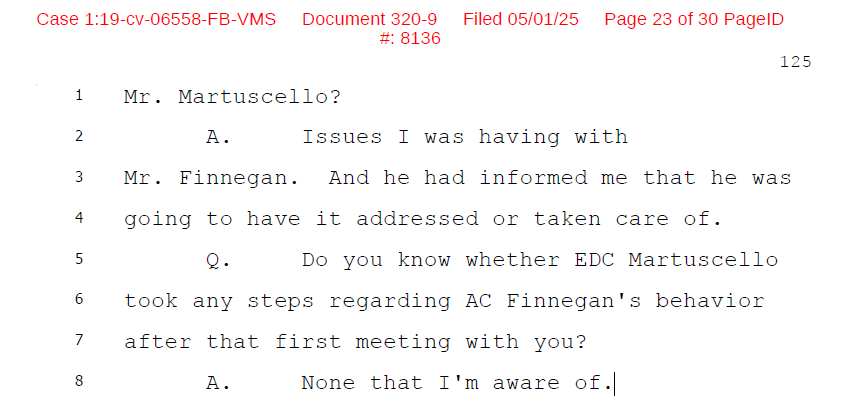
Sworn testimony by Donald E. Venettozzi, Director of DOCCS' Special Housing Unit and Inmate Disciplinary program, in a federal lawsuit by prisoners alleging they were wrongly disciplined for false positive drug tests. Source: court records, US District Court, Eastern District of New York.
Martuscello's mismanagement of the state prison system also led to almost 3,000 false administrative charges of drug use, according to a 2023 New York Inspector General's report. Officials in Martuscello's executive team in DOCCS' Central Office had early warning of false positives with new drug testing equipment DOCCS started using, but a personal dispute between two of the officials caused those warnings to be ignored.
At the time, Martuscello was then-Commissioner Annucci's second-in-command.
Martuscello was warned about the beef between Richard C. Finnegan, Assistant Commissioner of Special Housing, and Donald E. Venettozzi, the Director of DOCCS' Special Housing Unit and Inmate Disciplinary program, according to deposition testimony Venettozzi gave in a lawsuit filed by two prisoners who falsely tested positive for drug use.
Venettozzi testified under oath he warned Martuscello Finnegan was a bully who bullied not just him but other members of Martuscello's executive team—and Martuscello did nothing.
Martuscello "informed me that he was going to have it addressed or taken care of," Venettozzi testified, but Martuscello never did anything "I'm aware of."
The no-nonsense federal judge overseeing the lawsuit, Frederic Bloch, was scathing in his criticism of the dysfunction Martuscello allowed to flourish that contributed to what Bloch blasted as a "scandal."
"Prioritizing personal feuds over the constitutional rights of incarcerated people raises more than the specter of conscience-shocking conduct," Judge Block wrote in his Feb. 6, 2026 ruling denying the defendants' request for good-faith or qualified immunity.
Back in early 2014, when Montegari accepted an invitation to serve as deputy chief of the sex crimes unit of DOCCS' internal affairs unit, the office itself was recovering from a sex crimes scandal of its own.
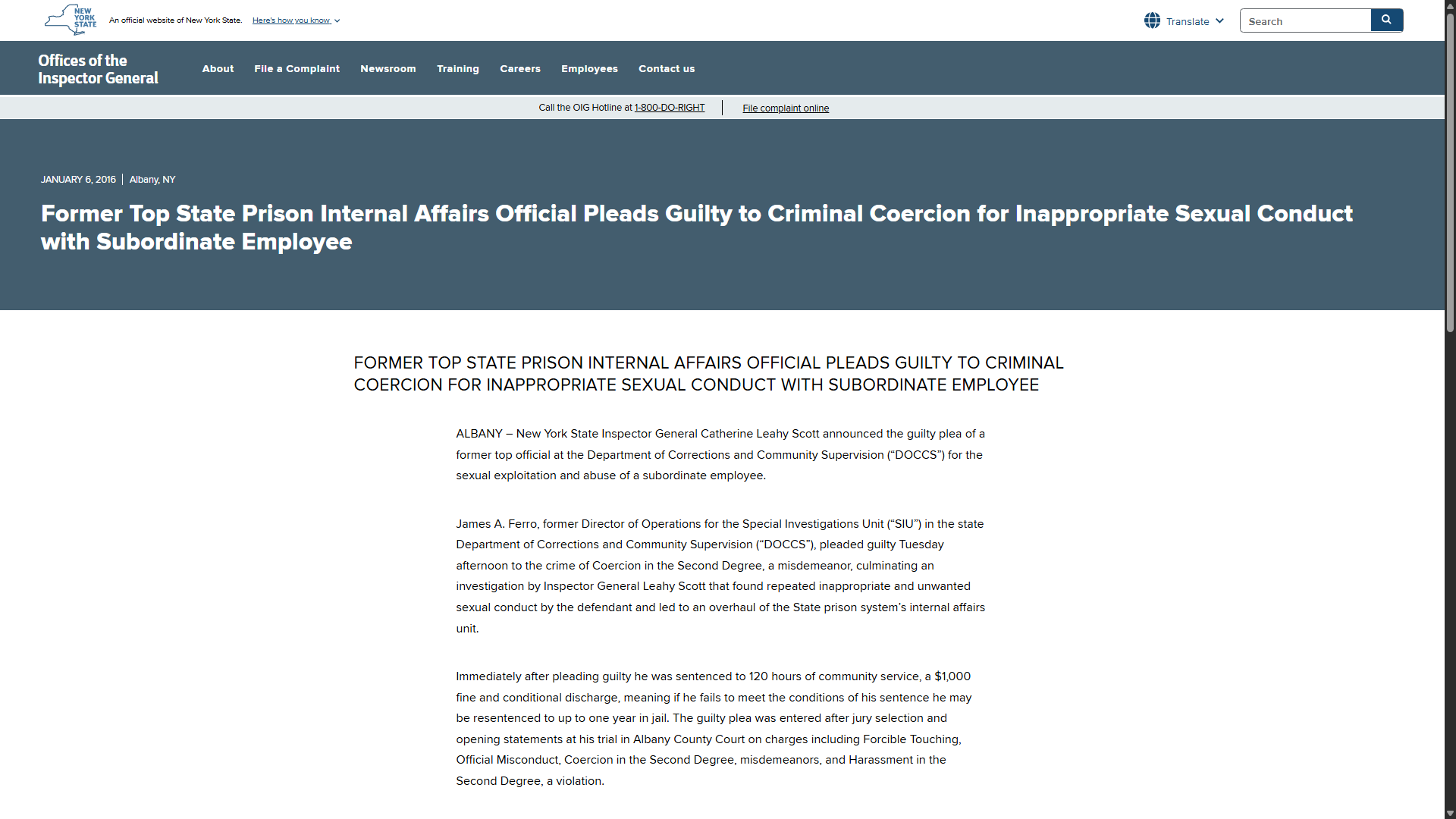
The Ferro Scandal is an under-reported precursor to #MeToo involving men, New York State government officials in the state's largest agency and bathroom sex assaults inside the agency's Albany headquarters.
James A. Ferro, former Director of Operations for what DOCCS then-called the Special Investigations Unit, pleaded guilty to sexual coercion, a misdemeanor, in 2016.
Ferro touched the genitals of the internal affairs investigators he supervised, touched his own genitals in front of them and touched or walked in on his investigators "while they were using toilet facilities," the Inspector General reported in a news release.
If Ferro was challenged, he "threatened employees—often former DOCCS corrections officers promoted to SIU to investigate allegations of misconduct within the prison system—with sending them back to the prison facilities from which they came to work alongside the corrections officers they were charged with investigating," the news release revealed.
Ferro's immediate supervisor in DOCCS' Central Office, Vernon Fonda, let Ferro get away with it, the Inspector General found. Fonda retired.
Fonda was tight with Daniel Martuscello's younger brother, Christopher, according to David Amodio, who also worked for DOCCS as an internal affairs investigator. At the time, Christopher Martuscello was in charge of the narcotics unit.
While Ferro was sexually terrorizing his workers, Martuscello himself was DOCCS' Deputy Commissioner for Administrative Services. His duties included overseeing both DOCCS' human resources department and its Bureau of Labor Relations. That made him doubly responsible for overseeing Ferro and disciplining him for misconduct.
Ferro committed sex crimes right under Martuscello's nose, in the same building Martuscello worked out of—if not the same bathroom.
In the aftermath of the Ferro scandal in 2014, the State Inspector General recommended DOCCS remake its internal affairs section. DOCCS changed its name from the Inspector General's office to Office of Special Investigations. Montegari was brought in in May. His mission: whip the sex crimes unit into shape.
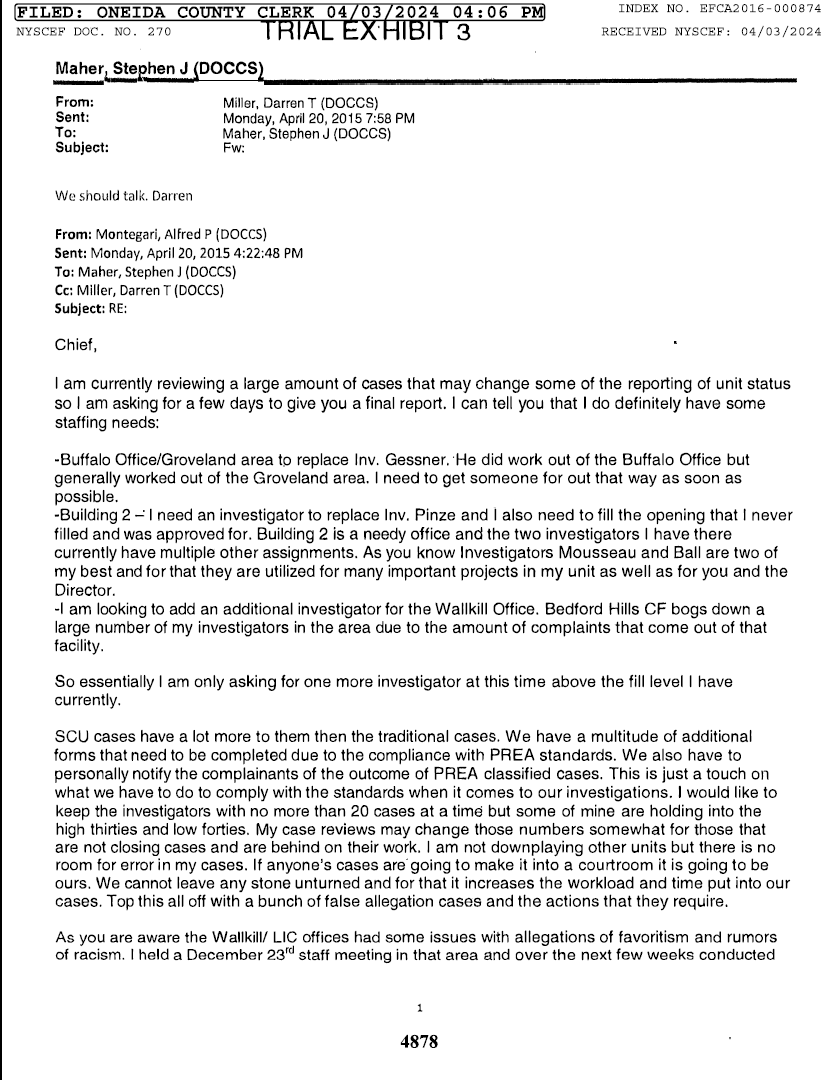
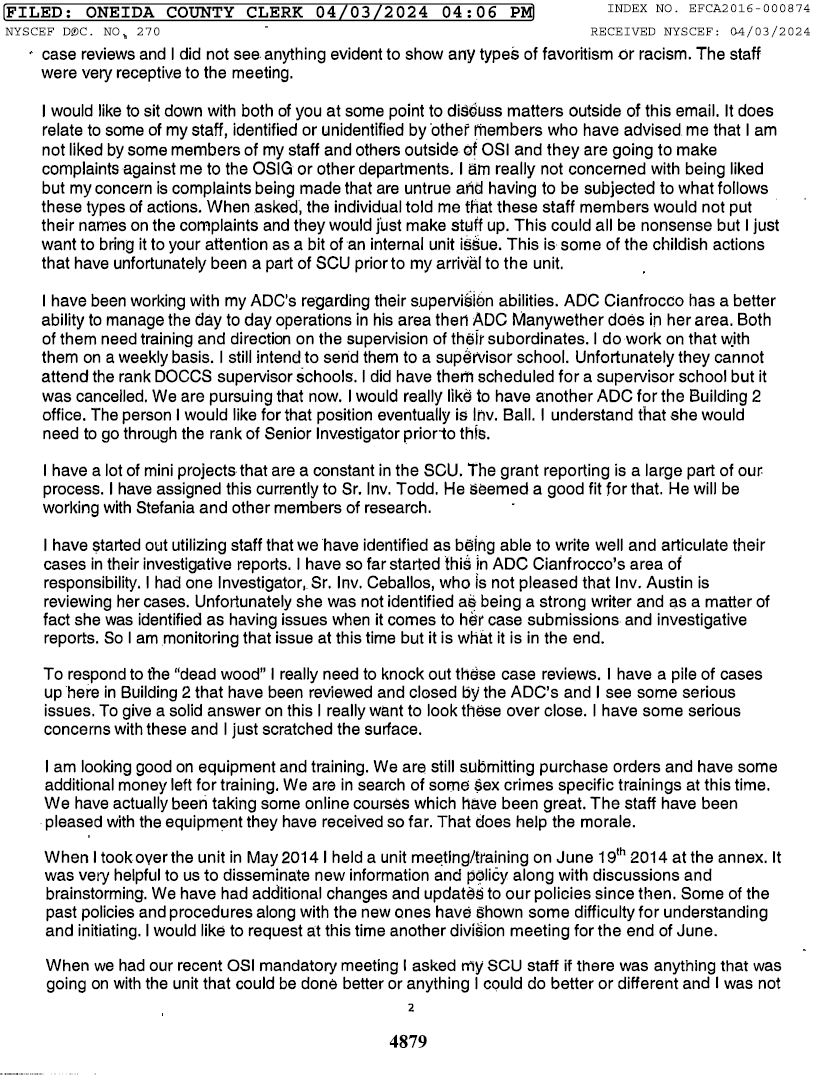
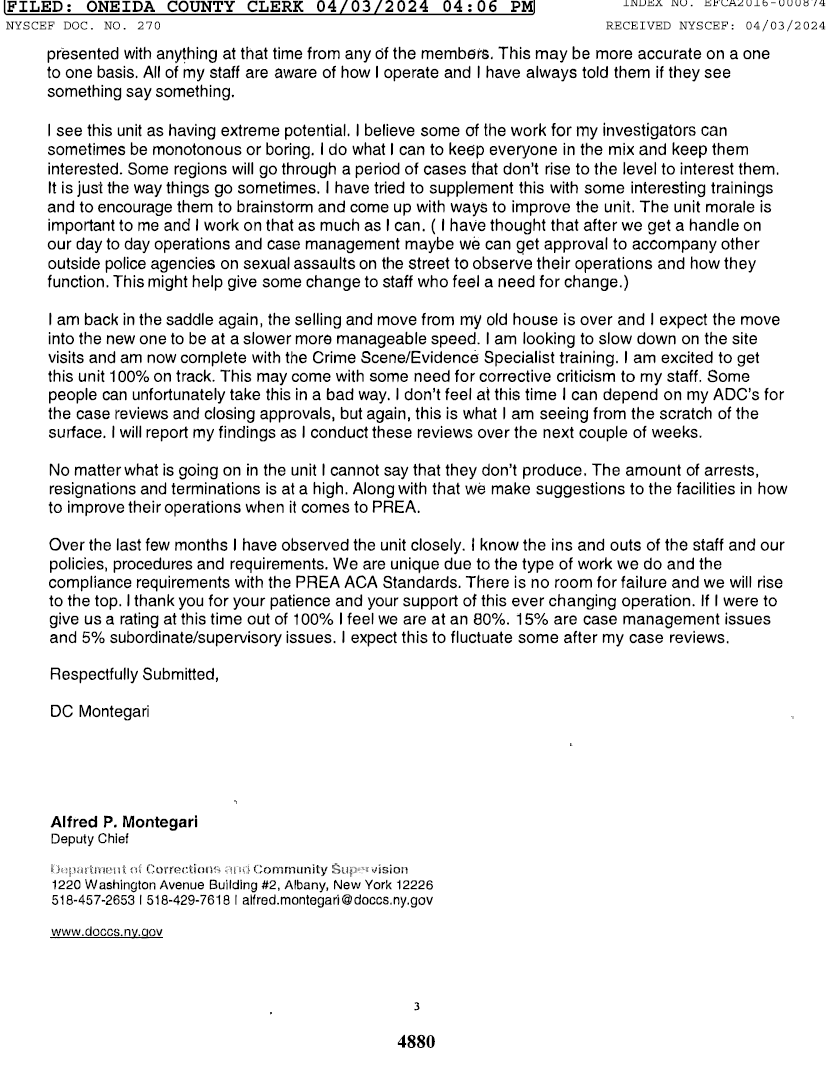
Email Montegari sent to high-ranking state prison officials exposing failures and alleged waste of taxpayer funds in the state prison system’s internal affairs unit. Source: New York State court records.
But, according to his successful lawsuit, Annucci, Martuscello and Miller decided Montegari's reform efforts went too far.
It started with a whistleblowing email from Montegari to his immediate boss Stephen J. Mahar, OSI's commanding officer. Montegari cc'd Darren T. Miller, Mahar's No. 2 man. In the Apr. 20, 2015 email, Montegari reported significant deficiencies in the way DOCCS conducted sex crimes investigations.
"I have a pile of cases up here in Building 2 that have been reviewed and closed by the ADC's and I see some serious issues," Montegari wrote, using an abbreviation for assistant deputy chiefs. "I have some serious concerns with these and I just scratched the surface."
Montegari also reported investigators had been assigned too many cases.
"I would like to keep the investigators with no more than 20 cases at a time," he wrote, "but some of mine are holding into the high thirties and low forties."
Montegari wrote he could not rely on subordinates to properly review and close out investigations without charges, "but again, this is what I am seeing from the scratch of the surface."
He promised to "report my findings as I conduct these reviews over the next couple of weeks."
Montegari never got the chance. He was suspended without pay two days later.
It turned out, Montegari was right to be worried about the integrity of the sex crime unit's investigations.
Joyce Mitchell was the subject of one of the investigations his unit closed. She was accused of having sex with prisoners.
After the investigation of Mitchell was closed, the Clinton Correctional Facility tailor shop worker helped Richard Matt and David Sweat escape the maximum-security state prison in June of 2015. Mitchell gave them hacksaw blades, chisels and more. She was sentenced to 2 1/3-to-7 years after pleading guilty to promoting prison contraband and criminal facilitation.
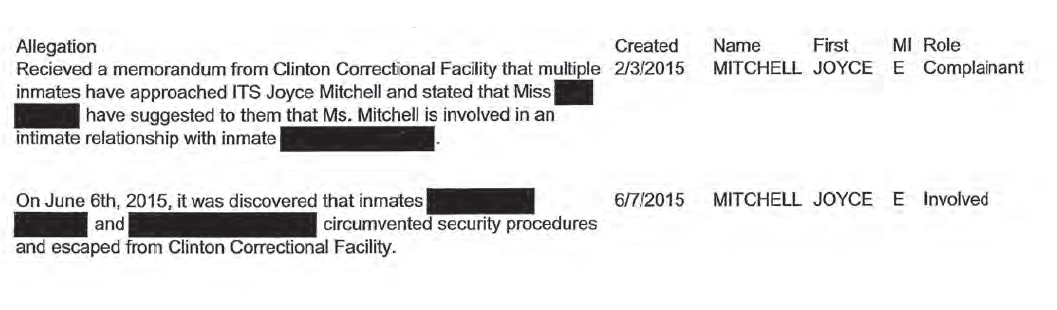
DOCCS OIS records documenting it received a complaint about the female prison employee who helped two prisoners escape a maximum-security prison before the escape. Source: New York State court records.
At his civil trial in 2023, Montegari called Amodio as a witness.
Amodio, to recall, was an Assistant Deputy Commissioner in OSI at the time Montegari worked there. Amodio revealed one of the things wrong with the way DOCCS' sex crimes investigations were conducted was investigators were trained to disbelieve uncorroborated allegations and dismiss them as "unsubstantiated."
"That was something we were taught right from the start, especially related to inmate allegations," Amodio testified. "Typically, the phrase was 'The benefit of the doubt goes to staff,' and investigations were shut down."
The same was true, Amodio testified, "If an inmate made an allegation and then changed his story or his—changed his statement when he was interviewed."
DOCCS, through its Director of Public Information Thomas Mailey, ignored a request to clarify if DOCCS' sex crimes investigators are still trained to always give "the benefit of the doubt" to staff.
"The Department has no comment on the litigation," Mailey replied in an email.
In Montegari's own 2023 trial testimony, he said he also reported to Mahar that the internal affairs unit's common practice of assigning investigators without regard to geographic location was a waste of taxpayer money. For example. Investigators based in Albany didn't need to drive out to Buffalo or New York City and stay in a hotel overnight to interview someone when a local investigator would do, or vice-versa.
Christopher Martuscello, Daniel's brother, called Montegari out for it.
"The way it was brought to me," Montegari testified, was "like, 'People are being a bunch of fucking crybabies, and it's now interfering with that Narcotics Unit that used to go out and do all of it.'"
That, Montegari said, got "some other people" talking.
The next day, Apr. 21, Montegari sent an email to his staff reminding them to adhere to the chain-of-command and not discuss "unit business outside of our unit" or "outside of OSI."
In response, OSI chief Mahar mocked Montegari in an email to Miller: "See the latest?"
"He seems insecure," Miller replied.
The day after that, Apr. 23, Daniel Martuscello, Christopher's brother, suspended Montegari without pay. Montegari was told to report to Martuscello's office. There, Martuscello handed him a suspension notice and told him to take a deal and resign from OSI or be demoted to sergeant. Montegari started crying.
Martuscello threw a box of tissues at him, according to Montegari.
"I was being treated like I was a criminal," he testified.
DOCCS' Bureau of Labor Relations, under Martuscello's direct supervision, filed 15 charges against Montegari and sought his firing. An arbitrator held a hearing on the charges in June and July. She issued her decision acquitting Montegari of all but one charge Oct. 5.
The one charge Montegari was convicted of was speeding in a state-owned car. That was based on his own admission to investigators.
The arbitrator ruled DOCCS should lift the suspension, give Montegari full back pay and restore his job as chief of the sex crimes unit. She said DOCCS should only reprimand Montegari for speeding.
The arbitrator's decision was only a recommendation under state law. Then-Commissioner Annucci had the final say. He followed the arbitrator's recommendations except for one: he did not reinstate Montegari as chief of the sex crimes unit.
Capt. Montegari was reassigned to work at a prison three hours away from his new home—even though a captain's slot was open at the Mohawk Correctional Facility, which was less than a half-hour away, evidence at the trial showed.
Montegari's made it to Mohawk a year later, in 2016. In 2022, Annucci made him Mohawk's superintendent. He retired in 2025.
The defendants can try to appeal the Appellate Division's decision affirming the jury's verdict to New York's highest court, the Court of Appeals, but that requires special permission and it is not likely to be granted.
AJ Bosman, Montegari's winning attorney, let her work speak for itself and ignored an invitation to comment on the appeals court’s decision.
She did, however, say one thing: “I just crossed over into Canada.”
Send tips or corrections to jasonbnicholas@gmail.com or, if you prefer, thefreelancenews@proton.me