NEW YORK CITY'S CUDDLIEST ANARCHIST JOHN PENLEY IS DEAD
RIOTS, RADICAL POLITICS, PROTESTS, POT, PHOTOGRAPHY AND CAT POWER
John R. Penley at the Savannah River Plant in 1989. Photo credit: John R. Penley, via the Tamiment Library and Robert F. Wagner Labor Archives at New York University.
MALONE, NEW YORK Oct. 8, 2026
John Rhodes Penley, an underground protest legend, who also chronicled Lower East Side life, infiltrated the Ku Klux Klan, dealt marijuana, almost helped nuke Arab countries during the 1973 Arab-Israeli War as a US Navy air traffic controller, and was, at one point, roommates with both bluesy doom queen Cat Power and the radical illustrator Seth Tobocman, is dead. He was 74.
"Resistance and struggle was John's driving force from the day I met him until the day he died," radical criminal defense lawyer Stanley Cohen told The Free Lance News on Tuesday. "His home was the LES, Loisaida, that was the core of his galaxy."
"He was a fighter," Cohen added, "and his close circle of friends were fighters of different kinds."
Clayton Patterson, the pre-eminent historian of the Lower East Side since he moved there from Canada in 1977, told the Village Sun in 2020 "John has certainly been hardcore on the activist trail for decades."
"No question he has earned his place as an LES legend," Patterson said. "He spilled his blood for that cause."
Even the right-wing New York Post loved the left-wing firebrand: the newspaper once called Penley "New York City’s cuddliest anarchist."
Maybe that's because the venerable tabloid once regularly published Penley's pictures, including on its front page.
Lincoln Anderson, who joined The Villager newspaper as assistant editor in 1997 and published Penley's photographs of news and life in lower Manhattan for decades, told The Free Lance News on Tuesday "John was an amazing photographer and really documented the East Village of the 1980s up through the early 2000s and beyond."
At the same time Penley was working as a news photographer, and credentialed as such by the NYPD, he was also illegally dealing marijuana.
"He was photographing," Anderson recalled. "He was dealing pot."
In fact, Penley "worked for the Pope of Pot," according to Anderson. "The first marijuana delivery service back in the 1980s. A lot of people say he was the original delivery service."
The Pope of Pot "died in jail," Anderson remembered. Penley did not.
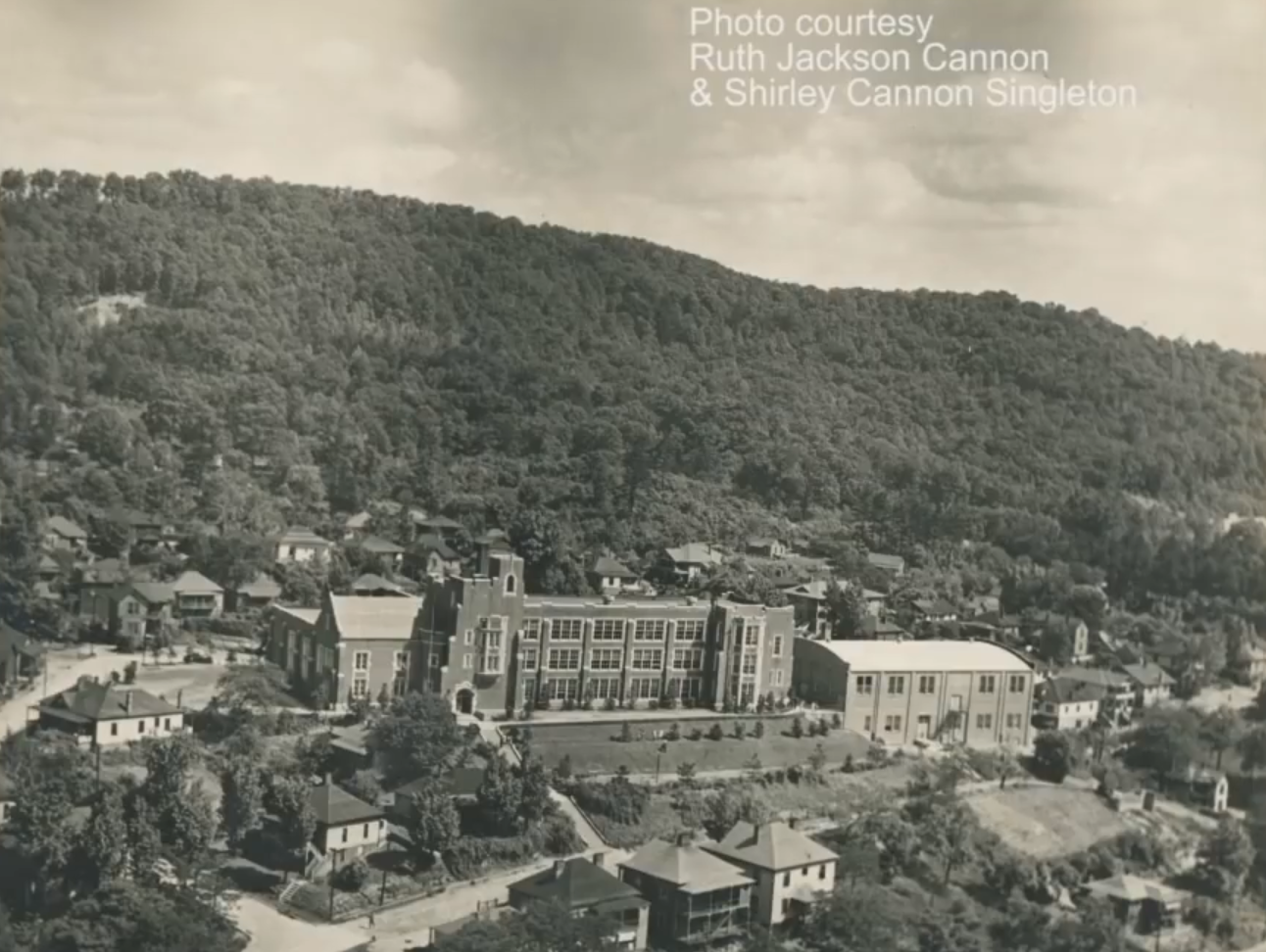
The Asheville, North Carolina high school where John R. Penley had a political awakening. Photo credit: unknown, via the Buncombe County Special Collections.
Football made Penley an activist.
He was 17 and a senior when his Asheville, North Carolina high school was desegregated in 1969. He was also a linebacker on the school's football team and co-captain of the defense.
"I'll be honest with you, the only thing I cared about was playing football," Penley told the Buncombe County Special Collection in 2018. "That was my thing."
Because football teams start practicing in August, the team and its cheerleading squad was desegregated first. The teenage Southern athletes made it work. But when the rest of the senior class showed up in September, they made history with what the newspapers remember as the "1969 Asheville High Riot."
"It definitely changed me," Penley admitted in 2018.
"I learned for one thing," Penley said, "if you have the courage to stand up for what you believe in, and you're willing to take the risk and do that, you can make changes."
Showing how carefully he studied protests since 1969, Penley declared "They did a good job of organizing that."
He also explained why. It was because "right at the same time during lunch time all the Black students walked out of the building and started protesting in front of the school."
The Asheville Police Department, he added, was "completely caught off guard."
The police "tried to get people off the school property and the kids went in the cafeteria." There they turned chairs into weapons "and started throwing it at the police. One of the teacher's Volkswagens got set on fire."
The protesters then started marching toward another Asheville public school. On their way, they encountered something they didn't expect. It wasn't police. It wasn't the Ku Klux Klan.
It was James Etheridge Penley, John R. Penley's adopted father.
The elder Penley was an assistant principal at that school. He got wind of the move and met the mob on its way, on the street. Whatever he told the teens is lost to history, but it persuaded them to go home.
Instead of arresting anybody later, officials made changes, Penley recalled. The changes included hiring black teachers and adjusting the curriculum.
"They were real smart," Penley said. "They didn't arrest anybody and they didn't press charges on anybody."
One of the reasons why was his father: "I know he had input into how it got handled."
Neighborhood racists weren't happy with the progressive outcome. They routinely telephoned the Penley home with anonymous death threats.
"Some people created some signs saying 'James Penley is an 'N' lover, and I will never use that word," John Penley said.
Racists even "put a homemade sign on the front door of our house and there was one posted up on Haywood road on the telephone pole."
It got worse.
"Someone broke in my dad's office in the middle of the night," Penley remembered, "and poured lighter fluid over his desk and set it on fire."
After that, the Asheville Police Department "had patrol cars coming by our house on a regular basis." Not only that, but the elder Penley began carrying a handgun, to work, at the school.
"My dad," Penley said, "he had a pistol."
Before 1969, "he didn't carry it, he kept it at the house."
But after the threats, he "started carrying the pistol when he went to school, and he continued to do that."
James Etheridge Penley, John Penley's adopted father, with his Marine Corp portrait in 2018. Photo credit: framegrab, via the Buncome County Special Collections.
Throughout Penley's high school years in the late 1960s, the Vietnam War raged. American high school kids were drafted into the US Army after they graduated to kill or be killed in a country on the far side of the Pacific ocean.
"All of us were afraid," Penley recalled in 2018, "after we graduate from Asheville high, where's our next stop? Vietnam."
He said he knew his "number was up for the draft" but that he "didn't want to go into the army." That's why, after he graduated in 1970, he "enlisted in the Navy."
"The Navy made me an air traffic controller and sent me to Crete and Naples Italy during the Cold War," Penley said.
During the 1973 Arab–Israeli War, American planes armed with tactical nuclear weapons were placed on alert at America bases throughout the region. That means they were fueled, loaded with bombs and pilots were sitting in cockpits waiting for the order to launch. As a US Navy air controller, it would have been Penley’s job to give that order and direct them toward their targets.
The US was prepared to nuke Arab countries to defend Israel, even though those countries lacked nuclear weapons, had not committed any act of war against the United States and Congress had not declared war.
It was entirely up to the president. That was Richard M. Nixon.
Penley came face-to-face with the raw truth that America is not just a country its an Empire.
It left Penley "severely disillusioned with the military," Sarah Ferguson, long-time LES resident and Village Voice journalist, reported in a profile of Penley for Downtown magazine in 1988. Penley didn’t just pout about it. He did something about it. Within weeks, Penley connected with Greek Anarchists.
Greece was ruled by a military dictatorship led by Col. Georgios Papadopoulos at the time. The Anarchists were determined to restore civilian rule. They instigated the Athens Polytechnic Uprising on Nov. 14. They occupied the university and used a pirate radio station to broadcast a call for citizens to take to the streets.
The junta responded with machine guns and mechanized infantry. The generals sent soldiers and tanks crashing through the university's front gate on Nov. 17.
The military massacred at least 40 students and injured about 2,000, but the Athens Polytechnic Uprising set in motion a chain of events that led to Democracy being restored—in Greece.
And Penley was there.
"He became involved," Ferguson reported, "with a group of Greek students who organized a shut down of the University of Athens that led to the overthrow of the Papadopoulos Dictatorship."
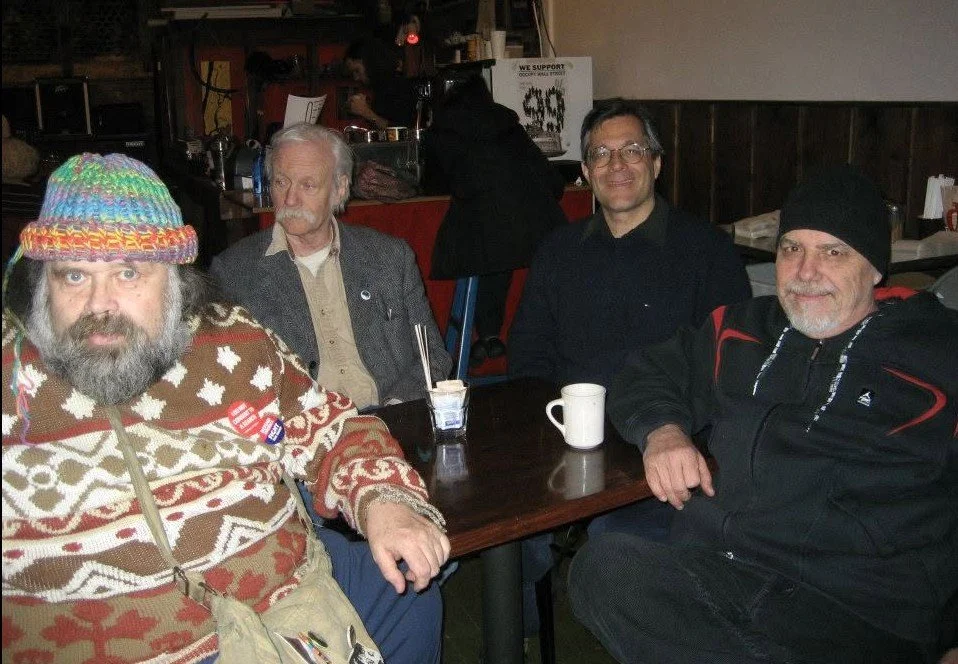
L-r: Aaron “Yippie Pie Man” Kay; Dana Beal, Zippie leader; Paul DiRenzo; and Penley, date unknown. Photo credit: unknown, via Facebook.
Vagabond Beaumont interviewed Penley about his life in 2013. Penley told the artist, writer and filmmaker the same thing he told Ferguson—that he had his Anarchist awakening in Greece, while serving in the Navy.
"You don't become an Anarchist," Beaumont explained, "you just realize that you are one."
"You always thought these things," he added, "but sometimes it takes someone to give it a name."
After Penley was honorably discharged from the US Navy, he returned home and began organizing protests. He helped organize a pro-pot rally at the University of Florida in Gainesville, which he said "was the first one ever in the State of Florida," and an anti-nuclear rally at the University of South Carolina on May 30, 1982.
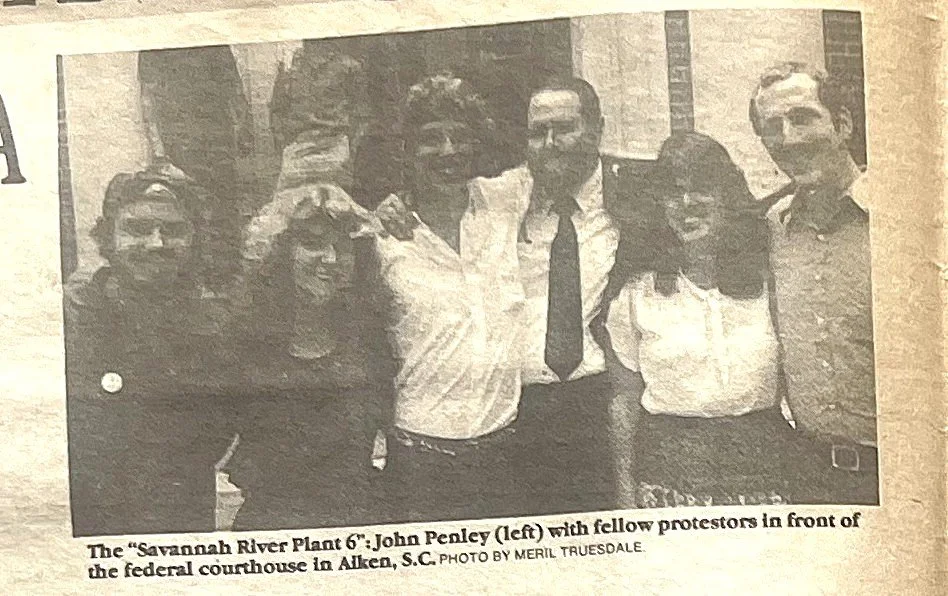
The day after the anti-nuke rally, Penley and five other people walked across the lawn in front of the administration building at the Savannah River Plant—where the US Government makes the plutonium and tritium for the bombs in its nuclear arsenal. They were arrested for trespassing. They never got near the building. When they were arrested they were still on the grass.
Penley said he and the others came to be known as the Savannah River Plant Six, which a yellowed newspaper clipping confirms.
Penley represented himself at the trial. He attempted to subpoena Pres. Ronald Regan, Secretary of Defense Casper Weinberger and Secretary of State Alexander Haig. The judge quashed Penley's proposed subpoenas.
The judge did allow Penley to call a prominent anti-nuclear activist as a witness for his defense, but only outside the presence of the jury to first determine whether he’d allow them to hear it. Penley said Phillip Berrigan testified anyone involved in nuclear weapons production, or protecting it, "'was just as guilty as the Nazis.'"
The judge seemed to take it personally, Penley said. He did not allow the jury to hear it.
Penley was convicted in August. Before he was sentenced, he jumped bail and went underground.
"I became a federal fugitive for 3 1/2 years," Penley told Beaumont during the 2013 interview. "Got all the way to Nicaragua. That's where I started doing documentary photography."
Penley got a camera and started taking pictures of "the Sandinistas and the Contras and getting my photos published in a radical paper called The Guardian—which was a national radical paper." (Not the British newspaper.)
"Eventually I got picked up by Nicaraguan immigration and arrested and put in jail there for 30 days," Penley told Beamont. "And at that point they gave me an option to renounce my US citizenship and join the Sandinista Army or go back to the United States and go to jail."
Penley chose America, and prison.
"I went back to Miami, was arrested," he said. "I did pretty close to a year."
From Miami he was taken back to South Carolina and incarcerated at the Columbia County jail.
"In Columbia it was pure hell," he said. "I mean, it was really bad."
But then Penley said he "wrote a letter to the Columbia newspaper about how bad the conditions were in the jail.” The paper published the letter. “The next day these federal marshalls came over and took me out to another jail, which actually was a lot better."
"I should've wrote that letter earlier," he concluded.
Fittingly, Penley finished his sentence at what was then called the United States Penitentiary—Atlanta. Pres. William McKinley ordered its construction in 1899. That's the same year he was laying the foundation for American’s growing Empire. Like the prison he ordered built, Pres. McKinley didn't live long enough to see either completed.
He was assassinated by an Anarchist bullet in 1901.
Public records show Penley's federal prison identification number was 22170-004. He was released Oct. 25, 1984.
"When you get out of federal prison they offer you a bus ticket where you want to go and a $100," Penley recalled. "I go, 'New York.'"
His first stop was Yippie HQ on Bleecker Street.
The Yippies, formally known as the Youth International Party, were founded by Abbie Hoffman and Jerry Rubin in 1968. They established a base of operations in a tenement at 9 Bleecker Street in 1973, according to long-time Lower East Side-based reporter Colin Moynihan.
From their LES stronghold, the Yippies then a more aggressive faction guided by Dana Beal called the Zippies plotted "large-scale events, including demonstrations at national political conventions and worldwide marches calling for the legalization of medical marijuana, among other causes."
During the pro-pot protest at the University of Florida in Gainesville, Penley said "A bunch of hippies came to it from Atlanta and brought down a paper that they were circulating, their own paper called the Yipster Times."
The Atlanta hippies he met "suggested that I come up here to New York and hang out." The address of the Yippie HQ was on the paper's masthead.
The Yippies in New York welcomed Penley with wide open arms.
"This is the first place I came," he told Beaumont, smiling, sitting inside the Yippie Cafe, before the Yippies were finally evicted from the building in 2014. "I lived here in this very building for a few months. Part of the time I lived across the street at Studio 10."
Studio 10 was a rock club. The Yippies had an entire counter-cultural operation.
"And right next door," Penley revealed, "the Pope of Pot had his pot delivery service.”
He called it this one block there was all kinds of crazy stuff going on."
The Peace Pentagon—home to the War Resisters League and generations of activists—was also on that block.
Through the Yippies, Penley said he "met Abbie Hoffman. I met Bob Fass from WBAI. I met Wavy Gravy who was the MC at Woodstock. Dhourba bin-Wahad eventually. The people that started the Rainbow family, Garrick Beck, Joanne Freedom. I met people from the Living Theatre here, Judith Malina. I mean the list goes on and on."
After his death, Beck wrote Penley was "One of the All Time Great Activists of our era."
Beck rattled off his good qualities: "Brilliant strategist, wise and articulate public speaker, organizer extraordinaire, longtime Rainbow Gatherer, and a kind and compassionate human being. A model for all of us."
Penley agreed the Yippies were really good at "manipulating the media to come and cover what you're doing. That's where I learned it all."
John Penley holding Village Voice reporter Sarah Ferguson’s 3-month old son Christopher Wagner under the Hare Krishna tree in Tompkins Square Park, July 28. 2008. Photo credit: JB Nicholas.
After profiling Penley for Downtown magazine in 1988, Ferguson, the long-time LES resident and Voice reporter, stayed friends with him.
"John was an OG Yippie,"she told The Free Lance News on Thursday. "He was a media prankster and that's very in keeping with the Yippies."
When Penley landed on the Lower East Side in the mid-1980s, groups of organized squatters had taken over and begun fixing up some of the scores of abandoned tenement buildings the city owned there. In the late 1980s and 1990s, the City wanted to take them back. The squatters resisted.
Ferguson said Penley became a “a kind of ad hoc strategist for the protests erupting over the park curfew and the homeless and riotous battles over the squats in the neighborhood.” He also collaborated "with people like squat activists Michael Shenker and Seth T and Stanley to help foster this radical protest scene in and around Tompkins Square Park." He "did a lot of DC protests too."
Her friend, she recalled, "was so many different things," but above all he was a "lovable rascal."
Beaumont, the filmmaker, was born in Brooklyn and raised in Queens. He first met Penley in 2001.
"We were running in the same Lower East Side circles," Beaumont told The Free Lance News on Monday, "CHARAS, C-Squat, Bullet Space, ABC No Rio, all those places."
"People like John come to the City and get everything," Beaumont explained. "They would see it. They would understand."
Not so much now, but back then the City "was a magnet for freaks and weirdos."
"If you were a freak and weirdo in North Carolina people would look at you funny," the native New Yorker explained. "If you'd come to New York and be a freak and weirdo and people would welcome you."
"John wasn't queer," Beaumont said, "but he was a weirdo and he knew it."
Anderson, The Villager newspaper editor, recalled that when he got the job in 1997 Penley "took me out to Lucky Chens"—staffed by Drag Queens—and introduced him to "Michael Shenker and Stanley Cohen."
"Shenker," Anderson explained, "was a big squatter leader and Cohen was their lawyer. He was a lawyer for a lot of the community battles back then."
Looking back, Anderson says it was "really cool" of Penley to introduce him to the neighborhood's news-makers. "I really appreciated it. I covered them regularly after that."
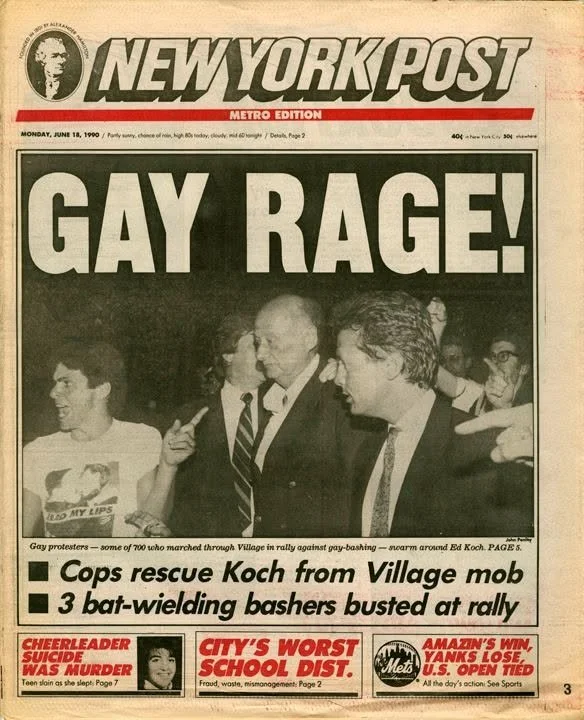
One of John Penley’s front-page New York Post photographs. See photo credit,. lower right of photo.
As underground as Penley's Lower East Side life was, he kept a foot solidly planted in the mainstream world by working as a professional photojournalist for the City's top newspapers—bringing the camera skills he learned in Nicaragua to bear on the streets of New York.
"I bought a police scanner so I could listen" to NYPD radio transmissions of crimes, fires and other chaos in progress, Penley said. When he heard something potentially newsworthy in lower Manhattan, he would rush out of his Lower East Side apartment and photograph it.
The City's biggest newspapers in those years, the New York Times, the New York Daily News, the New York Post and New York Newsday, all had regular photographers who covered the streets during the day, but nights were only minimally covered by the Lobster Trick. Nighttime was when enterprising freelancers made their mark.
"I would work at nights," Penley said. "I would stay in my room in the apartment and listen for stuff to happen. Run out, take pictures of it, go to the corner payphone, call the newspapers and see if they're interested."
If one was, he would "Hop a cab, take the film into the newspaper. The next day, it would be in the paper."
“You name it, I photographed it,” Penley told Anderson for The Villager in 2009.
Penley proudly recalled those days.
"Very few people have had the feeling of one of their photographs being on the cover of a daily paper in New York City," he said, "but the next day everywhere you go in the City your photo is on the newsstand everywhere."
"It was just such a thrill to have that happen," he added.
He said one of his favorite front-page photographs was from an Act Up! protest in 1990. The gay rights group was marching from the West Village to the East Village "because some Act Up! members had been gay-bashed on St. Marks."
Along the way, former Mayor Ed Koch stepped off the curb to cross the street with a bodyguard. It was a provocation. Koch was not well-liked by the City's gay community. Penley captured the inevitable confrontation.
The Post put it on the cover the next day under the headline: "GAY RAGE!"
Another one of Penley's favorite, and most famous, photographs captures a "tank"—technically an armored personnel carrier—the NYPD deployed on 13th Street to evict squatters from a building there in 1994.
This photograph is in New York University's permanent collection at the Tamiment Library and Robert F. Wagner Labor Archives, along with thousands more of Penley's photographs.
"My photos have been published everywhere," Penley told Beaumont in 2013, "on the cover of every single daily paper in New York."
"I did regular assignments for the New York Times covering the Lower East Side for what was then called the City Section which doesn't exist anymore," he said. "I did that for about 10 years."
Magazines also published Penley's work. New York Magazine used one of his photographs of Keith Haring for its obituary.
"I was full-time working as a photojournalist," Penley said. "But under the table I was working with the squatters, and the Anarchists and the homeless people camped in Tompkins Square Park."
He was so close to the street, "I was accused of actually starting a riot so I could get pictures of it. But it never happened."
He quickly added he knew who did start it: "I know who threw the first bottle. 'Cause they was standing right next to me. Then I did pull my camera out."
However, both Cohen and Ferguson said Penley did not hesitate to cross what ordinary journalists would consider an ethical line that should not be crossed.
"Sometimes he would create the news that he would cover," she recalled. "He would tip off Page Six then he would go photograph it and sell it to the Post."
Cohen remembered a time when the NYPD were evicting a squatter group from a building whose residents Cohen was representing. He was negotiating for their surrender but what he was really doing was stalling for time.
Meanwhile, he said, "John was taking photographs and helping the squatters escape the police through the back window of the squat."
NYPD “tank” on East 13th Street. Photo credit: John Penley, via the Tamiment Library and Robert F. Wagner Labor Archives at New York University.
Cohen first met Penley around the time of the infamous 1988 Tompkins Square Park police riot.
"John Penley was a purist Anarchist," he said. "John was one of those guys when the cops showed up and told him to move, that made him want to stay more. When the cops tell you to move, you're usually in the right place."
"We developed a very close personal relationship," Cohen told us. Penley was his "very close and good friend over many years."
Penley, Cohen revealed, "had three great loves. One was his cameras. The other was justice. The third one was being an argumentative pain in the ass."
He had an uncanny ability to sniff out the fakes.
"He could tell fairly quickly when someone was the real deal," Cohen said. "He was not a fence-sitter. You were good or you were not."
Being an Anarchist activist didn't make Penley hopeless. It meant the opposite.
"John had fundamental faith in youth," Cohen explained, "and new generations to get it right."
Penley had faith in America too—perhaps unexpected from an Anarchist. That's what his decision to return from Nicaragua and go to jail to reclaim his citizenship proved.
While history does not arc toward justice, and every American generation has to fight for their rights against new and old enemies alike, along with technological advances, the Constitution and the individual rights it guarantees makes that fight winnable.
"With his politics," Cohen dryly observed, "I can think of 50 countries he'd be disappeared and that would have been the end of John Penley.
Still, after 9/11, Penley encouraged Anderson, The Villager's editor, to join the military, he said.
"'Lincoln you're old enough you can go and fight,'" Anderson recalled Penley telling him. "At that time, people were unified because we had been attacked."
After crashing with the Yippies, Penley moved into an apartment on East 3d Street between Avenues A and B. There he lived with Tobocman, the illustrator. Ferguson recalled visiting.
"Seth had one side," Ferguson said. "Penley was on the other side."
It was like the "Odd Couple" TV sit-com, she added, because Penley was a "neat freak" while Tobocman wasn't.
"There's like drawings all over the floor," she said. "Dishes piled up in the sink."
Penley kept a mini-fridge and a mini-bar in his room so he didn't have to use the kitchen.
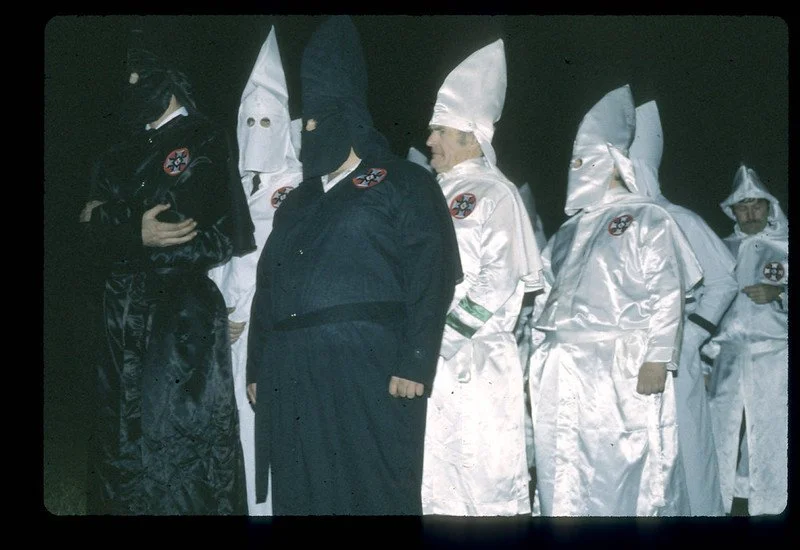
Penley infiltrated the annual gathering of the Ku Klux Klan to get this photograph of Ku Klux Klan special forces and the Imperial Wizard in 1992, Pulaski, Tennessee. Photo credit: John Penley, via the Tamiment Library and Robert F. Wagner Labor Archives at New York University.
Then Cat Power moved in.
"Chan had a room there too," Ferguson said. "She was a kind of famous rock person at that point. She wasn't there a lot. She was mostly on tour."
One time, she said, she went over to visit Penley and found him laying on his bed, phone in hand, with Rush Limbaugh blasting from his radio.
"He would call these right-wing talk-radio hosts like Limbaugh and Mark Levin and totally fuck them on the air," Ferguson said.
Screeners were supposed to stop him, but Penley outfoxed them by playing the show on his radio loud enough for them to hear it and speaking in a masculine voice with a Southern drawl.
Ferguson said the topic the night she visited was gays in the military. Penley told them he was a Navy vet with "strong opinions" about it. When he was finally connected to Limbaugh, live on the radio, Penley pounced.
"'Yeah I feel strongly about gays in the military.'" Ferguson recalls Penley saying. "'I think there should be a lot more fags in the military and they should give out condoms too!'"
"Limbaugh huffed and cut him off, but Penley just lay back and cackled," Ferguson reminisced.
"He conned them again!," she said.
Anderson, the editor, said Penley was married to a Japanese performance artist who "got naked on a sheet on Avenue A." That was Nozomi Oye. She was a Jazz singer too.Their marriage was short and did not yield children.
"She really broke his heart," Ferguson said.
She died in California around 2012, Penley said in social media post.
Penley started spending months at a time in Oaxaca, Mexico in the 'Aughts. He sold marijuana to tourists on beaches and DJ'd oceanside raves as "Gringo Loco."
"That's the name they gave him and he would DJ parties down there," Anderson said.
"He would come back re-charged," Ferguson remembered. "I think New York burnt him out."
"I loved seeing his Devilish smile," she said.
But this part of Penley's life ended when it became too dangerous for Penley to deal there.
"Gangs took over his spot and he stopped doing that," Ferguson said.
Back in New York, Penley quit working as a photojournalist around 2004. Cohen—the all-purpose neighborhood civil rights lawyer, spokesman and social worker—gave him a job.
Cat Power moved out. Something happened between Tobocman and Penley. Penley had to move out in late 2008 or so.
When he could not find a place to live, on his meager budget, in the rapidly gentrifying LES, Cohen let him crash at his Avenue D loft when he wasn't there, and at his west Catskill mountain hide-out when he was.
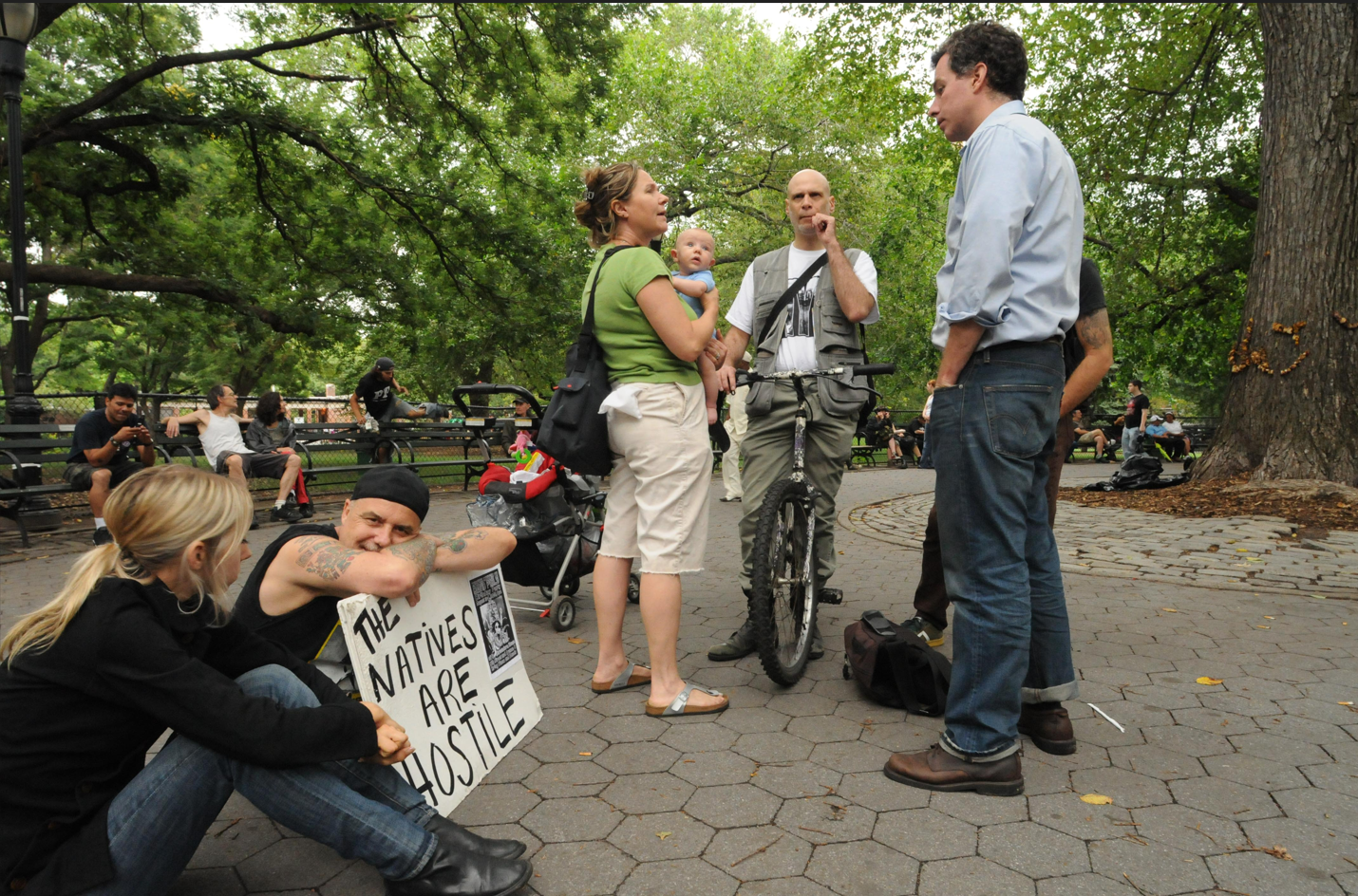
L-R: John Penley (seated, holding sign); Village Voice reporter Sarah Ferguson, holding son Christopher Wagner; political commentator and WBAI radio journalist Bill Weinberg (on bike); and New York Times reporter Colin R. Moynihan, under the Hare Krishna tree in Tompkins Square Park, July 28. 2008. Photo credit: JB Nicholas.
Though Penley stopped working as a news photographer, he didn't go cold turkey from the news.
"He was like a news junky basically," Anderson said. "There was always something. Even in his older age, he'd be pitching stories."
Moynihan, writing for the New York Times, published a report on Penley from this time headlined "Reporter Sans Portfolio Is a de Facto East Village News Bureau" in 2008.
For decades, Moynihan wrote, "Mr. Penley, 55, has been a font of ideas and information, offering unpaid advice to reporters from those who work for local weeklies to those who work for dailies that circulate across the country."
"Many of the leads he provides end up in print. His name and phone number are recognized by many reporters and gossip editors, and when Mr. Penley calls, they often listen."
Moynihan even got Richard Johnson, editor of Page Six, The New York Post's gossip column, "where dozens of Mr. Penley’s tips have landed," to speak on the record about Penley.
“He’s got his ear to the ground and he knows what people are talking about,” Johnson told Moynihan.
Beaumont, the film-maker, too was amazed at Penley's ear for the street.
"Penley would hear about stuff that I didn't even hear about," the native New Yorker said. "He was tied in."
Meanwhile, Penley led a ragged band of graying true believers that grew smaller every year in rear-guard action.
There was the "Die Hard Yuppie Scum" protest in 2008, for example. A flyer Penley posted around the neighborhood said it aimed at "real estate developers, landlords, yuppie wine bars, republicans."
While he was flyering, he bumped into Steve Schirripa—an actor who played Robert "Bobby Bacala" Baccalieri on the HBO mob drama The Sopranos. Penley handed him a flier and shook his hand.
That's the way Penley was. He was always trying to make allies. He was strategic like that.
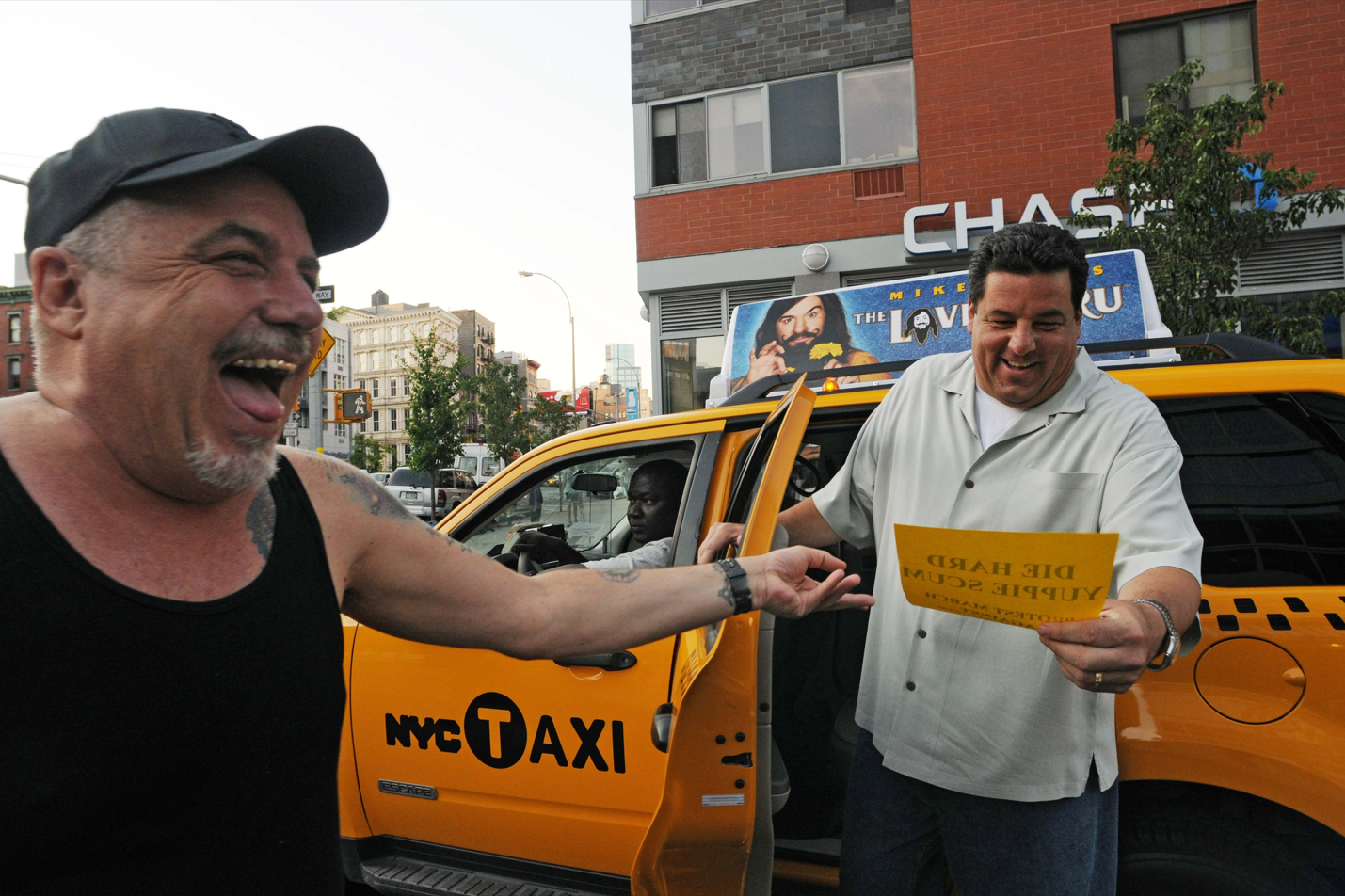
John Penley handing a protest pamphlet to actor Steve Schirripa on the Lower East Side in 2008. Photo credit: JB Nicholas.
Things picked up again for protests and Penley in 2011.
Chelsea Manning, then a US Army Intelligence Analyst, was busted on May 27, 2010 for leaking classified information to WikiLeaks. She was jailed in a military brig and moved to the Marine Corps Base at Quantico, Virginia for military court martial.
Penley and the artist-activist Clark Stoeckley had a mutual friend: Vlad Teichberg. Teichberg is a coder who exchanged Wall Street riches for political activism. He pioneered live-streaming protests during the Arab Spring. He was also one of the architects of the Occupy Wall Street movement.
Techiberg hooked Stoeckley up with Penley. The trio met up for a pro-Manning rally outside the White House on Mar. 19, 2011.
Penley and Teichberg took a Chinatown bus to Washington, DC, then a cab to Stoeckley's hotel, the former Key Bridge Marriott, a brutalist masterpiece, across the river in Arlington, Virginia.
"It was after midnight when they arrived," Stoeckley wrote The Free Lance News on Wednesday from the Middle East, where he is an Associate Professor of Art and Graphic Design at American University of Kuwait. "We kinda pulled an all-nighter."
Stoeckley came up with the idea to build a WikiLeaks "mobile depository" truck—and drive it to the White House protest. It was just the kind of publicity stunt Penley loved: a Yippie-esque spectacle.
"The next morning John helped me install the vinyl graphics on the WikiLeaks Truck in the hotel parking lot," Stoeckley wrote.
He also photographed Stoeckley finishing up the installation.
"John rode with me as I did laps around the White House in the WikiLeaks truck," Stoeckley detailed.
"As we were leaving I was pulled over and arrested by Secret Service." Penley "chewed them out for an unlawful and unnecessary arrest." Then, because he didn't have a driver's license, "he found someone to drive the truck so it wasn't impounded."
Later that night, Penley picked Stoeckley up at the police station when he was released. The next day the three went to another rally for Manning. This one was held outside the gates of Quantico. Daniel Ellsberg, the source of the legendary Pentagon Papers leak, was arrested at that protest.
Teichberg was helping plan Occupy Wall Street at the time and Penley, of course, was in on it.
"We talked about the Arab Spring and how we should do it in the US," Stoeckley said. "That was the first day I heard the words 'Occupy Wall Street.'"
In the meantime, Stoeckley took the WikiLeaks Truck on drives through DC. Sometimes he parked it outside the federal courthouse there. Especially when people were called to testify before the Grand Jury investigating Manning.
Occupy Wall Street was planned in Tompkins Square Park.
Penley, Teichberg and Stoeckley reunited at Zuccotti Park in lower Manhattan six months later on Sept. 17.
"I showed up to OWS with the truck on Day One," Stoeckley said. "Penley rode with me as I did laps around the Financial District. We hung out there for the next two months.”
After Mayor Mike Bloomberg unleashed the NYPD to evict Occupy Wall Street from Zuccotti Park, Penley helped Stoeckley organize an OWS bus trip to Ft. Meade, Maryland for the first day of Manning's pre-court martial proceeding—which was to determine whether there was enough evidence to court-martial Manning.
Military Police wouldn't let Penley onto the base, Stoeckley recalled, "because his only ID was his VA card."
"He flipped out on them," Stoeckley disclosed. "It was hilarious but also scary."
Stoeckley started working as a courtroom sketch artist that day, covering Manning's court martial. Later he collected the courtroom sketches in a graphic novel, The United States vs. Pvt. Chelsea Manning
The last time Stoeckley saw Penley was at Ft. Meade for another Manning protest in June 2013.
"The weekend before the trial portion of Manning's court-martial we had a huge rally," Stoeckley recalled. "The biggest one."
"John was one of the baddest motherfuckers to walk this Earth," Stoeckley concluded, "yet one of the kindest and caring people you would ever meet."
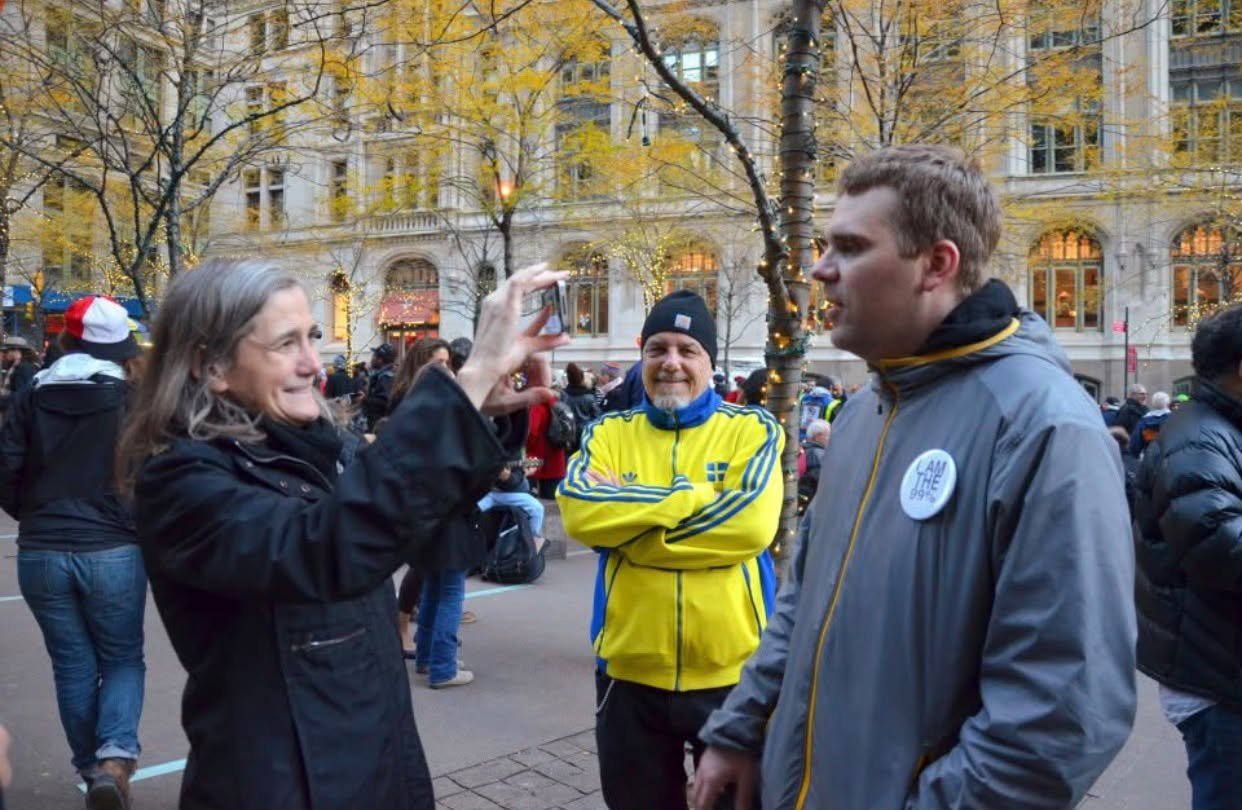
L-R: Amy Goodman of Democracy Now!; Penley; and the artist-activist Clark Stoeckley in Zuoccotti Park during Occupy Wall Street in 2011. Photo credit: unknown, via Clark Stoeckley.
Family duty called Penley back home in 2012. His father was in the early stages of dementia and needed a companion.
"It was sort of sad seeing his exit from New York," Ferguson said. "He never really recovered from losing his place on Third Street. That was homebase."
He came back to New York City for a few days at NYU's request to organize his archive in January 2013, but NYU refused to get a hotel room or some kind of temporary university housing. His photographs were good enough for its archive, but Penley the man wasn't deserving enough for a warm bed.
So Penley did as Penley has always done: he organized a protest. He slept on the street in front of the Elmer Holmes Bobst Library. He also invited Beaumont to interview him, sitting there, on the street, in January, as freezing sleet fell on them. If it was an attempt to shame NYU, it didn't work.
Penley aged but did not mellow in Asheville.
He picked up his camera and covered protests against the Confederate battle flag flying from the South Carolina state capitol in 2015. In 2017, he was back in Washington, DC when Donald Trump was sworn in as president, the first time. Later that year he went to Charlottesville to cover the Unite the Right rally.
After his father died in 2019, Penley said his surviving sister, Jaime Susann Penley, kicked him out of the family home. He moved to Las Vegas in 2020. He chose Vegas, Ferguson said, because marijuana was legal in Nevada, the city had a decent VA hospital and rent was relatively affordable.
He lived in Vegas for three years. Toward the end, he teetered on homelessness. He decamped to Lake Havasu in 2023. His health deteriorated in 2025. He was partially paralyzed later that year, in November, he said in increasingly angry and heartbreakingly sad social media posts.
The white Southern man who had fought for the rights of everyone else almost his entire adult life had no one to fight for him.
Only Paul DiRenzo, WBAI's Headline News Editor, appears to have visited Penley in his final weeks. (If I’m wrong and you did, I’d love to hear from you. Send me a message at the email address below.)
His death, on Sept. 15, was first reported by EV Grieve.
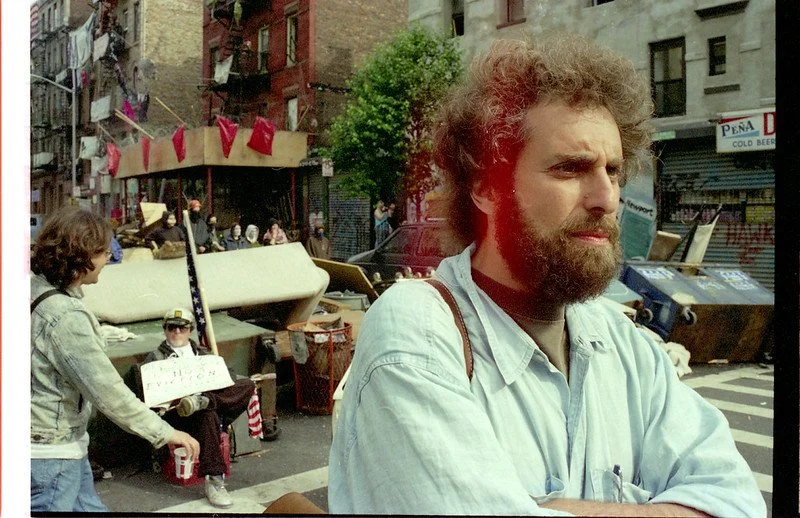
Stanley Cohen, Esq., on East 13th Street, 1994. Photo credit: John Penley, via the Tamiment Library and Robert F. Wagner Labor Archives at New York University.
Cohen, the lawyer, said he was literally haunted by Penley's death.
Cohen was representing a young woman being sentenced in a northern New York courtroom when, he said, he "saw John standing between us with that sarcastic stare of his as he tossed his middle finger at the Judge."
Cohen said his client's previous lawyer got her to accept three years in prison as part of a so-called plea-bargain. Now all Cohen could do was try to convince the judge to impose a lesser sentence. It was theoretically possible but not likely.
"With the three of us taking a seat John whispered in my ear: 'Tell that judge to fuck off we need justice,'" Cohen said he imagined he heard.
That's exactly what Cohen did. The judge stared. The prosecutor froze. Court officers appeared hypnotized.
Cohen said "I stood up, as did John right next to me, and told the judge about a wonderful fighter who may have lost his life but who was very much alive in this courtroom inspiring me to revisit our journey."
"I spoke of John and his lifetime chase of justice especially for the young, like our client that day," Cohen explained.
"I recounted his battle to help save the youth shelter on 8th Street between 1st Avenue and Avenue A in Loisaida," Cohen continued, "noting that our client before the court would no doubt have found comfort and redemption in that brownstone, as did the many dozens of other young women and men living in the squats of the LES, or on its streets, or in the park all the while with JP standing next to them."
When he finished speaking, Cohen said "the judge reflected a bit” then "looked down at us and said 'probation.'"
Outside the courthouse, Cohen saw Penley's ghost one last time.
"As his image began to fade," Cohen said, "I told him 'I love you brother.'"
Send tips or corrections to jasonbnicholas@gmail.com or, if you prefer, thefreelancenews@proton.me