YES GLORIA STEINEM REALLY WAS A CIA SPY: DIVE INTO THE DIRTY DETAILS HERE
HISTORIAN RASHIDA SHAFIQ DOCUMENTED STEINEM'S YEARS AS A CIA OPERATIVE: 'SEEMED LIKE A GOOD USE, BETTER THAN BUYING PLANES AND BOMBS,' THE FEMINIST ICON QUIPPED IN 1975
MALONE, NEW YORK Sept. 6, 2026
Was Gloria Steinem a CIA spy? That's the question the Internet has been asking since news of her death broke last Wednesday.
The shocking truth is "Yes," for four years, she was. It started when she was 24 in 1958. It ended when she was 28 in 1962.
She knowingly took CIA money to send American kids overseas to Communist youth festivals in Europe in 1959 and 1962 and report on it to US officials. In 1967, she exposed her involvement in the caper to the New York Times. She was unrepentant about it until the end.
“If I had a choice I would do it again,” Steinem wrote in her 2015 memoir, Life on the Road.
STEINEM IN INDIA
To fairly consider Steinem's defense of her CIA collabo, it's worth examining what she did first, in India.
Steinem graduated magna cum laude with a degree in government from Smith College in 1956. She spent her junior year studying at the University of Geneva in Switzerland. There she wrote a paper on the Communist Party of India. That earned her a Chester Bowles Fellowship when she graduated that sent her to India for 18 months.
The fellowship was part of what a later generation call "soft power"—ostensibly international diplomatic or humanitarian initiatives that facilitate American hegemony.
When Steinem first landed in India, she lived for a time with Ellen Roy, widow of MN Roy who headed the Communist Party of India "until it was ordered by the Soviets to support the British during World War II, and then he left to form the Radical Humanists," Steinem told journalists Meenakshi Mukherjee and Ira Pande for an interview with India International Centre Quarterly in 2007.
Rashida Shafiq, a historian who earned a doctorate from Southern Methodist University, documented Steinem’s Indian years in her Aug. 4, 2026 thesis, The Method and the Machinery: Gloria Steinem, India, and the Cold War Making of American Second Wave Feminsim, 1956-1972. After chopping it up with Roy, Steinem traveled on foot throughout Tamil Nadu, India's southernmost state and home to its minority Tamil population—a distinct sub-population with a distinct language.
At the time, Tamil Nadu was riven with political violence between a caste of land-owners called Thevars and a caste of landless "untouchables" called Dalits. Thevars dominated local politics and historically exploited and oppressed the Dalits. On paper, that changed when Dalits were guaranteed legal equality by a new provision of the Indian constitution in 1950. In practice, Thevars used lethal force to resist the grant of full human rights to Dalits.
The immediate trigger for the riots in Tamil Nadu in 1957 was the murder of a Dalit activist during a hotly-contested special election—allegedly by Thevars. After the murder, Thevar gangs rampaged through Dalit villages, robbing, raping, burning and killing at will. Dalits retaliated.
The national Indian government responded by sealing off the area to everyone including journalists—effectively imposing a news black out. Grassroots groups of peacemakers snuck past police lines in an attempt to mediate the deadly dispute and restore order. These were led by Vinoba Bhave, one of Mahatma Gandhi's disciples and a veteran of the Indian Independence Movement that finally freed India from colonial English rule in 1947.
Steinem joined one of Bhave's groups after traveling to his ashram and finding it deserted. An elderly keeper of the place hipped her to what was going down. Each peace team needed at least one woman. There were more men ready to go but no women. Would she do it? Yes. All she took with her was “a cup, a comb, and the sari I wore,” she later recalled in Life on the Road.
Their mission, she said, was “to hold meetings, reassure people they weren’t abandoned, and dispel rumors worse than reality—an on-the-ground effort to reverse the violence.”
Steinem walked from village to village through Tamil Nadu with the team speaking and listening to Thevars and Dalits alike.
"I listened as villagers narrated burnings, murders, thefts and rapes, with fear and trauma needing no translation,” Steinem wrote. “People seemed relieved to see each other, talk, be heard, distinguish truth from rumor, and realize that outsiders knew or cared.”
She added she saw this as “the ancient and modern magic of groups in which anyone may speak in turn, everyone must listen, and consensus is more valuable than time.”
Shafiq, the historian, wrote Steinem the activist leader was born in these rare and dangerous yet powerful moments.
"What she did learn, viscerally and on the ground, was that profound social change begins not with ideology but with listening," Shafiq writes. "Her weeks [there] showed her that dialogue, empathy, and shared presence could begin to break cycles of violence and lay the groundwork for lasting reconciliation."
Steinem herself agreed.
“Going from village to village with Vinoba Bhave’s followers and learning about Gandhian activism probably helped me to become what I am today,” Steinem told Mukherjee and Pande in 2007.
"If you want to know how people live, you have to go where they live," she explained then. "If you want people to listen to you, you have to listen to them. I learned that in India.”
(A prison reform activist The Free Lance News spoke with, who worked with Steinem late in her life, noted Steinem did exactly these things when they began collaborating in 2016.)
Photo credit: unknown, source, Instagram @gloriasteinem.
BACKGROUND TO THE SCANDAL
After World War II, the Capitalist United States and western European nations fought a "cold war" against the Communist "Eastern Bloc" led by the Soviet Union. The Cold War lasted until the break-up of the Soviet Union in 1991. During that time, the American-led "Western Bloc" competed against the Eastern Bloc in almost every conceivable way, from high school test scores to nuclear weapons to space exploration.
One arena of competition was for the hearts and minds of the world's future leaders: teenagers and college kids all over the planet, especially from non-aligned nations in Asia (such as India), Africa and South America. Starting in the 1950s, the Soviet-funded International Union of Students competed against the International Student Conference. The co-founders of the ISC included the US National Student Association, a CIA-funded operation first exposed by Ramparts magazine.
The chief battleground these two student groups fought over was Communist-organized World Festivals of Youth and Students. The recorded history of these contests suggests the Commies threw the coolest parties and the CIA was always trying to crash or sabotage them. In its March 1967 edition, Ramparts revealed the CIA secretly funded the US National Student Association and, thereby, also indirectly supported the pro-West International Student Conference.
It was a major scandal, since the CIA was supposed to only operate outside the United States and not spy on Americans.
Also, what student would want to join either the NSA or the ISC knowing it was funded and spied on by the CIA?
As serious as this 1967 scandal was, it was relatively tame compared to subsequent CIA scandals revealed by the Church Committee in 1975. And it pales in comparison to the post-9/11 straight off-the-chain, dystopian future CIA that rendered, tortured and killed—as documented in the 2014 Senate Report on CIA Torture.
THE CIA RECRUITS STEINEM
Clive Gray—the NSA’s vice president for international affairs and a secret CIA operative—recruited Steinem. The State Department ran something called the Foreign Student Leadership Project. Its goal was to bring students to the US for a year of study then send them back to spread the American gospel. Maybe also spy for the CIA. The CIA vetted candidates. The Ford Foundation funded it.
Gray was in charge of recruiting FSLP candidates from India the year Steinem was there. He got Steinem to recommend three candidates, Shafiq documents based on a report Steinem herself sent back to Washington as part of her fellowship.
"Someone had sent him my home-town-girl-goes-to-India clipping from the Washington Post, and he looked us up," Steinem wrote of Gray. "It turned into a good mutual arrangement."
She did not know at the time the NSA was a CIA front, according to Shafiq.
A year later, back in the states, Gray recommended Steinem to CIA case officer Harry Lunn. Lunn was a former NSA president who joined the CIA. Lunn gave Gray the greenlight. Lunn told Steinem a group of former NSA officials was standing up a group to send non-communist American students to the 1959 World Youth Festival in Austria.
That was a big deal at the time because Austria was a neutral, non-aligned country.
Steinem agreed to become co-director of the group, which they named the International Reporting Service—the IRS. Sydney Stern's 1997 biography of Steinem reports she did not know the IRS was funded by the CIA—at first. Steinem’s IRS colleagues eventually informed her “the CIA would fund the IRS through foundations, so money would not be a problem.”
Steinem was duped into signing up, but once she knew she stayed.
She never detailed exactly how she was recruited. But when Ramparts revealed the CIA was secretly funding the US National Student Association in 1967, the magazine reported it typically went like this. First prospects were selected by CIA officers who were themselves former NSA members. Then they were evaluated "for their reliability—as well as a full national security check by the CIA."
In Steinem's case, it was Gray and Lunn—a former president of the NSA—doing the vetting.
After a prospect cleared the screening, they were invited to lunch by a CIA asset (Gray) and a representative of the CIA (Lunn). The prospect was told "there was information relating to work on the international staff which affected national security and which he should know about, but which required him to sign a national security oath."
"If he signed the oath," Ramparts reported, "he was then told about the CIA relationship and asked to cooperate."
If a prospect agreed to cooperate, that meant he or she must obtain the CIA's approval for overseas activities.
"Grants for international programs, travel allowances and expense accounts for NSA members going to overseas student conferences, would then all be supplied by CIA-front foundations," according to Ramparts.
Dr. Clive S. Grey in the woods in Vermont, where he retired. “Clive loved the outdoors, especially bushwhacking, fishing, and camping at Long Pond, a landscape he worked to protect,” his obituary says. He was a board member of the Nature Conservancy and donated his family’s 256-acre forest to the group which it named the Barr Hill Natural Area. Photo credit: Karen McNeill Saielli, courtesy of the Nature Conservancy.
WHAT DID STEINEM GET OUT OF IT?
According to a letter Shafiq found in Steinem's papers in the Smith College Special Collection, she thought her CIA job was “something meaningful.” She was paid $100 per week plus $5-per-day "per diem for housing—roughly $1,070 per week and $54 per day in 2026 dollars."
Ramparts said one "of the lures the CIA dangled" to students "was the assurance" their cooperation would not require them to compromise their "foreign policy principles." The CIA wanted to support "alternatives to communism ... even if the only alternative is a moderate left." Prospects were also "told that, in working with the CIA, they would be providing the information that would help get a more enlightened foreign policy presented in high Washington circles."
For a recent college graduate in their 20s, or a graduate student, working with the CIA "meant lots of money, a sense of doing important work, overseas travel, and, perhaps most important of all, very little feeling of having sold out one's political convictions."
For men, it also meant something invaluable after the Vietnam War started: an official deferment from the-then mandatory military draft.
Michael Wood, who blew the whistle on it all, wrote in an epilogue to the Ramparts report that working with the CIA made him feel "an unusual sense of personal liberation." While some students were "actively involved in many of the insurgent campus and political movements of the day, we were also able to move freely through the highest echelons of established power."
"It gave us a heady feeling and a sense of power beyond our years," Wood explained. "The mobility and influence was as it should be for a national union of students; to learn that it had been bought with so terrible a compromise made me realize how impotent we really were."
WHAT EXACTLY DID STEINEM DO? INFORMATION WAR
Once signed up to recruit American students to attend the 1959 World Youth Festival in Vienna, Steinem's CIA handlers had her move to Cambridge, Massachusetts. Cambridge is home to Harvard University. Her office was directly across the street from it. Many more colleges and universities surround it.
It was, in short, prime hunting ground to dupe America's best and brightest into working for the CIA.
The IRS's "main objective," according to Shafiq, "was to infiltrate the festival by deploying pro-Western American students to counter Soviet propaganda." A secondary goal "was to demonstrate to the American public that not all students attending the Vienna festival supported communism."
Steinem's work, Safiq concludes, "demonstrated a sophisticated understanding of psychological warfare."
Steinem recruited unwitting student delegates, prepared them for the task with role-playing workshops and planned to publish a daily newspaper covering the festival with the CIA's perspective baked into the fake "reporting." It was called the Vienna Daily News. She also wrote and published a pamphlet to about 6,000 participants, “The Background of the Vienna Youth Festival.”
The CIA was especially concerned about how racial discrimination against Blacks in America was "weaponized against the United States in the Cold War battle for Third World opinion," Shafiq reports. "Without apparent irony, the IRS also produced supplementary pamphlets and fact sheets addressing topics including what its 1959 materials called 'negro segregation.'"
These offered students "rehearsed talking points for managing potentially hostile encounters with students from decolonizing African and Asian nations." The goal was "to train American delegates to portray racial discrimination as a fading historical relic and to demonstrate that the United States was reforming its democratic flaws from within rather than denying them."
Steinem recruited about "100 noncommunist American students and young professionals to serve as independent delegates at the Vienna festival," Shafiq found based on her review of letters Steinem sent to the legendary American propagandist CD Jackson she found in his archive at the Eisenhower Library.
Much can be written about Jackson. He was a psychological warfare specialist who created Allied propaganda during World War II. After the war, Time magazine's founder Henry Luce picked him to be Time-International's managing director. Jackson was also Fortune magazine's publisher. Shafiq calls him "the chief architect of American Cold War propaganda."
Jackson helped fund Steinem's Vienna op.
Among Steinem's recruits:
Michael Harrington, author of the highly influential 1962 book The Other America and founding member of the Democratic Socialists of America;
Zbigniew Brzezinski, Pres. Jimmy Carter’s National Security Advisor; and
Julius Varallyay, who helped lead the student-led Hungarian Uprising of 1956 that was crushed by Soviet troops.
Harrington bailed. He refused the standard IRS conditions. He told them he intended to "attack American capitalism and foreign policy as vigorously as Communism. That did it. The offer of help was withdrawn forthwith, and I paid my own way, having nothing to do with what turned out to be the CIA’s dirty games," Karen M. Paget reports in her book, Patriotic Betrayal.
The Vienna Festival ran for 10 days: July 26 to August 4, 1959. Steinem set up three offices to run everything the IRS had to do. One was dedicated to the "International News Bureau," which published the Vienna Daily News. IRS operatives also passed out books banned by Communist countries, including George Orwell’s 1984 and Boris Pasternak’s Doctor Zhivago.
Shafiq says they had fun with it: they even smuggled "non-communist newspapers into campground outhouses so they could not easily be confiscated."
Finally, IRS operatives provoked "confrontations with festival guards to generate headlines unfavorable to the communist organizers."
"Steinem found herself at the heart of a complex operation that combined diplomacy, propaganda, and outright espionage," Shafiq summarizes. Steinem was constantly on-the-go. Instead of sleep, there were late-night strategy meetings. "Stay-a-wake" pills fueled her peripatetic efforts.
"She was under constant surveillance throughout the operation, Soviet agents recorded everyone who entered her office," Sahfiq reveals, "and she was followed by a persistent tail throughout the city."
During it all, Steinem executed a clandestine op that stole the Communist spotlight: she smuggled Gyalo Thondup into Vienna to speak to the assembled world press. Thondup was the elder brother of the 14th Dalai Lama and a leader in the Tibetan resistance to Chinese occupation. Months before, Tibetans revolted, and the Dalai Lama was forced to flee Tibet for India. Thondop in Vienna was a Steinem coup. It demolished the glowing, glossy Sino-Russian narrative about Tibet.
The infrastructure and resources needed to pull it off suggests a high-degree of cooperation between the IRS and the CIA.
The CIA considered the Vienna op a success: a "minor disaster" for the Soviets, Paget reports.
Steinem thought she did a good job too. In a letter to an aunt she compared it to the anti-fascist activists who went to Spain in 1937 in a brave but failed fight to keep Generalissimo Fransico Franco's forces from taking over the country, according to a letter published in Carolyn G. Heilbrun's 1996 biography, The Education of a Woman: The Life of Gloria Steinem.
I really had a Europe-1937 sense of urgency once I got there and saw how much there was to do and how few people there were to do it. I think it struck a lot of us the same way. It’s a realization that, pretty often, the men who run everything are simply guys with gravy on their vests and not too much between the ears, and that you (one) can contribute toward disrupting the totalitarian works and convincing the uncommitted that it is wiser to remain in that state rather than exchanging Western colonialism for Communist imperialism.
After Vienna, Steinem moved back to New York City—and had enough clout to take the IRS office with her.
Her next CIA mission was to replicate her success in Vienna at the 1962 Helsinki World Youth Festival. According to Shafiq, "The Helsinki campaign represented a refinement of the methods Steinem developed in Vienna—a more professionalized and media-savvy version of the same kind of information war."
"From a small office in downtown Manhattan, Steinem helped to plan the entire counterpropaganda operation, recruiting a staff of journalists, students, and designers who produced professional-quality media on the ground in Helsinki," Shafiq reports.
While she did these things for the CIA, Steinem "also continued her part-time work at Help! magazine, where she served as a receptionist and recruited prominent show-business personalities to appear on the magazine’s covers."
Some of Steinem's Helsinki recruits went on to lead extraordinary lives:
Robert Kaiser, managing editor of the Washington Post from 1991 until 1998, retired in 2014 after 50 years of service to the newspaper;
Henry Raymont, music-loving United Press International foreign correspondent who first reported the US's failed Bay of Pigs invasion in 1961;
Sam Antupit, mid-century American magazine design legend;
Sheila Tobias, brilliant intellectual rebel who taught the first official women's studies college course in American history, coined the term "math anxiety" and published several books, including a 1982 consumer guide to military spending titled What Kinds of Guns Are They Buying for Your Butter?; and
Clay Felker, magazine magnate who helped birth "New Journalism," co-founded New York Magazine in 1968 as well as the eponymous Felker Magazine Center at USC's Berkeley’s Graduate School of Journalism in 1995.
At the time Felker worked for Steinem, he was a deputy editor at Esquire and finishing a book on a baseball superstar, Casey Stengel's Secret. Felker, Shafiq says, "became Steinem’s close friend, professional collaborator, and longtime partner."
Compared to fictional millionaire Jay Gatsby, Felker gave Steinem a popular mass media platform in 1968 when they co-founded New York Magazine. Felker also financed publishing the first, experimental issue of Steinem's successful Ms. magazine in 1971.
But before all that their first joint venture was cranking out Cold War propaganda.
Shafiq reports "CIA’s Ted Whittemore secretly supervised the newspapers the team produced, while photographer David Swanson received daily instructions from the US embassy on which images to capture."
There was also a CIA-sponsored Jazz club.
“Steinem became inadvertently associated with the operation after a photographer captured her parting the beaded curtains at the club’s entrance,” Shafiq reports , “an image that fed the ‘Mata Hari’ mythology surrounding her work for the IRS.”
(The Free Lance' News’s attempts to locate this photograph have so far been unsuccessful. If you know where a copy of it is located please send it to us or let us know at the email below.)
The operation was considered a success. Steinem took a victory lap in her final report: “Helsinki: The Last Red Festival.”
Notably, it wasn't published by the CIA-funded IRS. It was published in Show magazine's October 1962 edition. The same magazine she poached her Helsinki art director Sam Antupit from. The same magazine that, eight months later in June 1963, published her break-out, Nellie Bly-style expose of New York City's Playboy Club, "A Bunny's Tale."
She worked undercover at the club as a waitress, then reported what she saw. She put the spy-craft the CIA taught her to good use, kick-starting her career as a reporter with it.
Photo credit: unknown, courtesy of Gloria Steinem in her Playboy Bunny costume. Source: Gloria Steinem Papers (SSC- MS-00237), Sophia Smith Collection of Women’s History, Smith College Special Collections, Northampton, Massachusetts.
THE SCANDAL EXPLODES—STEINEM'S REACTION
Michael Wood, former head of fund-raising for the National Student Association, blew the whistle on the CIA's secret support of the group in 1966. He tipped off Ramparts magazine, which tasked reporter Sol Stern with sussing it out. By January 1967, Stern had completed his investigation and was calling the people he named in it for comment.
Phil Sherburne was NSA president when he disclosed the deal to Wood. Sherburne was at Harvard law by the time Stern got him on the phone. Wood had betrayed Sherburne's confidence. Stern asked him: "Did you sign a national security oath?" Sherburne replied: "At this point I don't want to make any comment."
By February, word must have gotten around because Neil Sheehan at the New York Times found out about it. Sheehan would go on to secretly photocopy the Pentagon Papers for the Times in 1971. Sheehan somehow managed to beat Ramparts at their own scoop. He broke the news that the CIA was secretly funding student groups Feb. 16. The Times buried the story on page A16.
Among the student groups named by Sheehan was the Independent Research Service.
"The organization was founded in 1958 by Paul Sigmund, now a professor at Princeton, and Gloria Steinem, a New York journalist, just before the Vienna youth festival of 1959," Sheehan reported. "In 1962, the Independent Research Service sent a delegation of more than 100 students, teachers and intellectuals to the Communist youth festival in Helsinki."
Four days later, Steinem, then 30, came clean to the New York Times. Mysteriously, both the original article and its digital reproduction lack a by-line.
Steinem told whoever wrote it that her experiences in India convinced her that American students needed to intellectually engage with other world youth at the Communist festivals.
"I came home in 1958 full of idealism and activism, to discover that very little was being done," she said. "Students were not taken seriously here before the civil rights movement, and private money receded at the mention of a Communist youth festival."
Steinem was quoted saying she "talked to some former officers of the National Student Association, who told her CIA money might be available to finance American participation" in the 1959 Vienna world youth festival.
"Far from being shocked by this involvement," Steinem reportedly said, "I was happy to find some liberals in government in those days who were far-sighted and cared enough to get Americans of all political views to the festival."
"I was never asked to report on other Americans or assess foreign nationals I had met," Steinem added. "The CIA's big mistake was not supplanting itself with private funds fast enough."
Steinem was also interviewed on TV by an as-yet-identified man.
She said that before she accepted CIA cash she tried to secure private funds for the initiative but failed.
"The Ford Foundation for instance told me that they thought we were too Liberal and too controversial," she said. "And the private individuals to whom I went often had particular points of view to put forward."
That, she said, "would have been much, much more restricting than the CIA funds were. Which were free. No one was told what to say."
"What do you mean they were free?," the interviewer interjected. "You mean it was easier to work for the CIA than a private organization?"
"That's right," Steinem answered.
She acknowledged that might "surprise" viewers. She herself said she shared the "conventional Liberal's view of the CIA is a right-wing, incendiary group."
That's why, she claimed, she was "amazed to discover that this was far from the case. That they were enlightened, Liberal, non-partisan activists of the sort who characterized the Kennedy Administration for instance."
She said when news broke that she had "for four years been a Central Intelligence Agent I was demonstrating outside the Pentagon underneath Secretary McNamara's office against bombing in Vietnam."
"This didn't precisely fit with the image of a CIA agent," she concluded, "but then neither does the CIA."
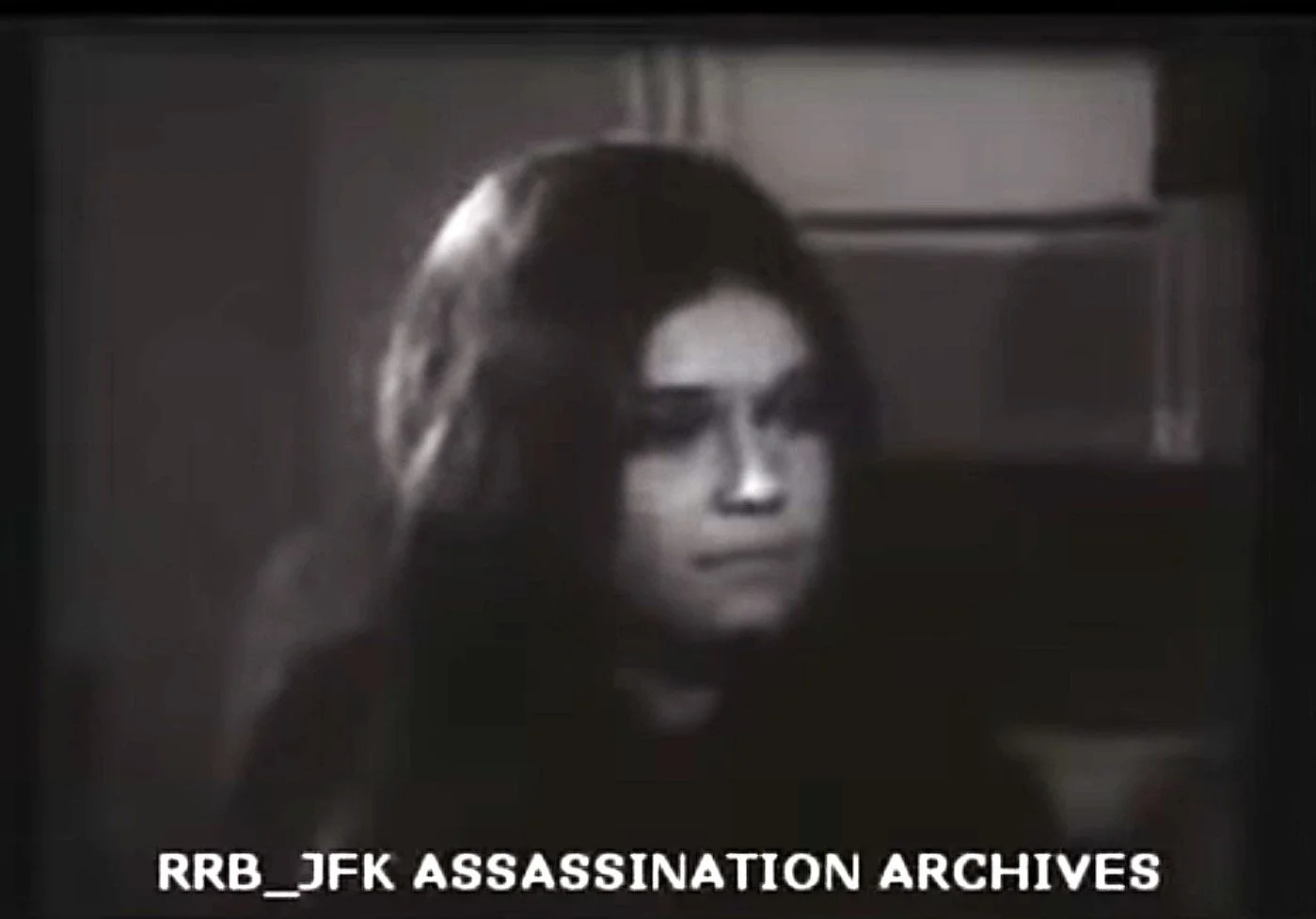
Gloria Steinem asnswering questions about her activities as a CIA operative from 1958 until 1962, circa about 1967. Photo credit: framegrab from video, unknown, via YouTube.
THE FALLOUT FOLLOWED STEINEM FOR THE REST OF HER LIFE
Steinem's CIA work was a blessing to her career, but also a curse.
She used her lofty perch at the Felker-funded, Felker-edited New York Magazine to chronicle women's issues. In March 1969, Steinem covered an abortion speak-out. The event was organized by Redstockings, a radical feminist group.
"It was a very, very life-changing event for me," Steinem told the New York Times in 2008. "To hear women stand up and tell the truth. In public. About something that only happened to women. And take it seriously. It was very, very important."
What Steinem witnessed in that church basement moved her to write After Black Power, Women’s Liberation—a founding text of the Women's Liberation Movement.
Redstockings never forgave her. In 1975 the group published a broadside personally attacking Steinem who—they charged—"had been meteorically installed into her current position as leader of the movement through the efforts of the mass media."
"In fact," the group said, "she was unknown to most women in the movement—or at best known to women readers of New York magazine as one of the sympathetic journalists."
"Unlike other prominent women's liberationists," Redstockings went on, Steinem was not active in any "women's group." She had not "written a feminist book" nor "won a Congressional seat." She didn't even play "a superb game of tennis."
"Much of the credit for this," they wrote, "must go to Clay Felker, publisher of New York magazine."
Susan Brownmiller, who established her credentials in the movement with her 1975 meisterwerk Against Our Will: Men, Women and Rape, agreed.
"Guys in the media chose Gloria as our leader,” she told the New York Times in 2016.
Redstockings acknowledged in its 1975 screed “that raising these issues will draw lines in the women's movement.” But it was important to openly discuss because, as the publisher of Ms. magazine, Steinem was "in a strategic position" to influence "feminist politics." She could also gather information about the "personal and political activities of women all over the world."
The broadside is believed to have been primarily written and edited by Ellen Willis and Kathie Sarachild. Sarachild because she is one of Redstocking's founders and a life-long critic of Steinem. Willis because the broadside says the Village Voice—who regularly published Willis's work at the time—spiked a previously approved article "critical of Ms. magazine" after Felker bought the downtown New York City-based newspaper in 1974.
It was "assigned by the old 'Voice' and bought but never printed by Felker's Voice," they alleged.
Willis died in 2006. Sarachild did not respond to voicemail messages left at telephone numbers public records say belong to her.
It wasn't just spite that moved Redstockings to put Steinem on blast in 1975. 1975 was the year the Senate published the Church Committee Report on "Intelligence Activities."
The report exposed CIA programs that drugged Americans to experiment with mind control (MKULTRA); illegally surveilled Americans on American soil and sabotaged protest groups, sometimes with deadly consequences (COINTELPRO); a domestic propaganda initiative that sought to compromise journalists (Operation Mockingbird); a domestic signals intelligence program (Project Shamrock); plus a bonus grab-bag of the CIA's worst crimes (Family Jewels).
It was so disgraceful that when right-leaning journalist John D. Lofton jr. dialed Steinem's digits for her re-act to the damning revelations, Steinem at first "denied any relation to the CIA," Lofton wrote in a May 10, 1975 column, Ms. Steinem's CIA Connection.
"I don't think it's funny to be lumped in with murderers and even if the press is half-right, that is what this group of Government people are," Lofton quoted Steinem telling him.
Only after Lofton called her back with more questions did she relent. Still, she didn't tell the whole truth even then. She told Lofton she thought it was a good idea at the time because the relationship was "at extremely long-distance and with no control”—a claim that appears to contradict the evidence detailed by many of her biographers and collected by Shafiq.
In any event, Steinem quipped, it “seemed like a good use, better than planes and bombs.”
EPILOGUE
The New York Times checked back in with Steinem in 2016 as part of its "Lions of New York" series. John Leland dived directly into Steinem's "career as a CIA operative" in his lede.
“It’s so interesting now," Steinem observed, "because the initials C.I.A. will make people believe anything.”
“It just wasn’t like that," she claimed, even then. "It just was so uncontrolled. As I remember saying at the time, if this was our grandmother’s money we’d be doing the same thing.”
The personal attacks by her fellow Feminists had cut her, badly, to the quick.
“They never called to ask me what I did,” she revealed. “That hurt more than anything.”
“If anybody still cares about what happened so long ago," she added, "I’m happy to answer any questions.”
No one, it appears, ever did.
The Free Lance News reached Dr. Shafiq by telephone on Sunday. She said she regretted not speaking with Steinem. She disclosed she'd successfully defended her thesis and was officially awarded a doctorate in philosophy with a major in history from Southern Methodist University in August. Dr. Shafiq said she prefers to be called professor.
Prof. Shafiq added in emailed statement:
I want people to recognize that Gloria Steinem’s political awareness, activism, organizational methods, tools, and tactics during the Women’s Liberation Movement largely originated from her formative and inaugural trip to India in 1957-1958. This assertion is supported not only by my own observations but also by her numerous memoirs, articles, and biographies, which emphasize this influence. However, this period of her life is often overlooked or disregarded.
Furthermore, I wish to clarify her associations with the CIA.
Initially, she served as the director of the Independent Research Service, working with them from 1959 to 1961-62. Towards the end of her involvement, her role was more part-time. The Ramparts article published in 1967 revealed that the NSA and IRS received funding from the CIA; people in the early 60s didn't know about that. She had no reason to suspect that the CIA, which provided the funding to send American youth to festivals, was the same organization involved in overthrowing socialist governments in Latin America. This information only became public through the Church Committee hearings.
Send tips or corrections to jasonbnicholas@gmail.com or, if you prefer, thefreelancenews@proton.me