CORRECTION OFFICER OUT OF COMA, RELEASED FROM HOSPITAL AFTER EXPOSURE TO MYSTERY ‘SUBSTANCE’; NEW 'PAPER' DRUGS RAISE ALARM
EXPOSURE TO SUSPECTED SYNTHETIC DRUGS SOAKED INTO PAPER SHEETS ALMOST KILLED A NEW YORK STATE CORRECTION OFFICER, PART OF TROUBLING NATIONAL TREND
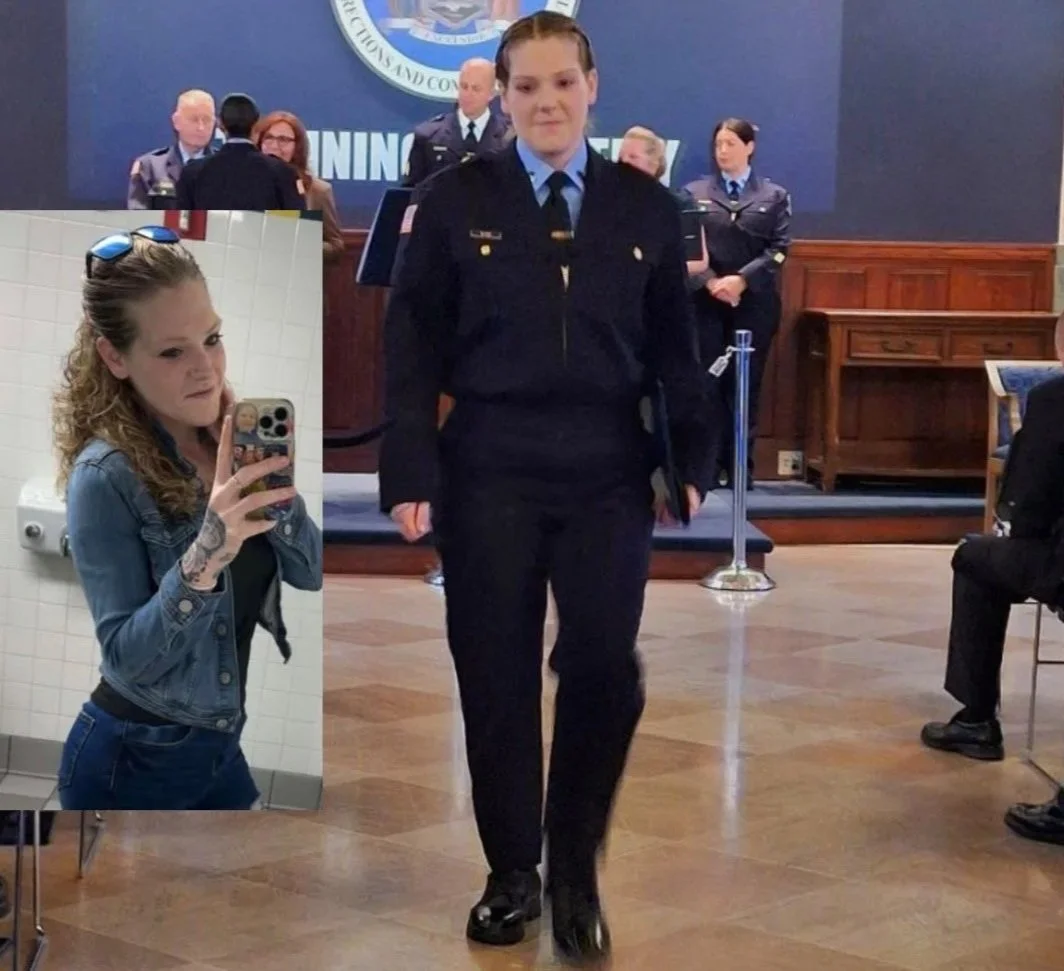
New York State Correction Officer Monica Tebo was almost killed by suspected sythentic “paper drugs” by a visitor allegedly attempting to smuggle them into the Mohawk Correctional Facility last Sunday. Photo credits: unknown, inset, Monica Tebo, via Facebook.
MALONE, NEW YORK Apr. 12, 2026
The New York State Correction Officer who was almost killed by exposure to a suspected synthetic drug while working in an upstate prison emerged from a drug-induced coma on Saturday and went home on Sunday.
Monica Tebo was screening visitors entering the Mohawk Correctional Facility last Sunday when one of them allegedly tried to enter the medium-security prison with "an envelope containing multiple pieces of paper believed to be saturated with an unknown substance," the State Police said in a news release.
The would-be visitor had the envelope in her back pocket, a source close to the case and known to The Free Lance News said. Suspicious, Tebo seized the envelope from Taylor and sniffed it.
Tebo's throat closed shut and medics had to insert a breathing tube into her windpipe to keep her alive, the source said. Transported to Rome Hospital, doctors sedated the 32-year-old mother-of-two and kept her breathing on a ventilator. On Friday, Tebo was transferred to a hospital in Syracuse. Doctors there removed her breathing tube on Saturday.
"Monica asked me to let everyone know she's doing well," Tyler Larkin, her boyfriend, said in a social media post Saturday afternoon. "The vent is out and she's breathing on her own and doing great."
The State Police confirmed several correction officers at Mohawk "who handled the materials began experiencing symptoms consistent with exposure to a hazardous substance." In addition to Tebo, two more correction officers were taken to the hospital for treatment. Two National Guard soldiers "reported possible exposure and were evaluated as a precaution," the State Police said.
One of the other correction officers who was released had to go back to the hospital the next day when they experienced additional difficulty breathing. She too has since been released.
Daniel F. Martuscello, Commissioner of the state agency that manages New York's prison system, the Department of Corrections and Community Supervision ("DOCCS"), said in a statement a day after Tebo was stricken "The difficult challenge of preventing contraband, and the resulting violence and danger it brings to everyone in correctional facilities, is constant."
"This incident is another example of that danger and our continuing work to root out contraband in our facilities," Martuscello's statement added.
State Police arrested Shondrea C. Taylor, 53, of Syracuse. They charged her with two counts of promoting prison contraband in the second degree, a misdemeanor punishable by up to a year in jail.
"The suspect ... was located shortly after leaving the facility and taken into custody without incident," the State Police said. "Further investigation revealed that Taylor entered the facility under the pretense of visiting an inmate and attempted to deliver the materials at the direction of an unidentified individual."
Police don't know what "the substance" that almost killed Tebo is.
"A preliminary assessment of the substance by responding hazardous materials teams was inconclusive," State Police said. "The materials have been secured and will undergo further laboratory analysis. The investigation is continuing in coordination with the DOCCS Office of Special Investigations."
The Free Lance News's source said the street value of "the paper" exceeded $100,000. But State Police spokesman Beau Duffy said on Saturday that "We can’t confirm a value until we know what it is.”
"The paper has been sent to a lab to determine what the substance is," Duffy said.
Tebo's mother declined to comment and her boyfriend, Larkin, did not respond to a request for comment.
For five years, prison guards in New York have been mysteriously and suddenly having serious trouble breathing while on the job. Since Narcan usually helps restore their breathing, the likely culprit has been assumed to be some kind of synthetic opioid, likely a Fentanyl-based derivative.
For example, 15 Correction Officers, eight nurses and an office assistant were stricken in four days at the Upstate Correctional Facility in January 2025. One of those nurses lost her unborn child after her exposure, her husband told The Free Lance News. Another dozen or so workers at Upstate were stricken eight months later in August.
When about 4/5s of New York's entire prison guard force went on an illegal strike in February and March 2025, strikers cited the chemical exposures as one of their reasons.
At first, DOCCS responded by tightly controlling information about what was happening inside its prisons. At one point, it even appeared to suggest to reporters inquiring about the mysterious incidents that guards and nurses were making it up. DOCCS repeatedly told reporters searches were conducted but "no known hazardous substances found."
DOCCS' attempt at spin control stands in stark contrast to the response administrators at Chicago's Cook County jail took when inmates started dying under "mysterious" circumstances there: they invited reporters from the New York Times to chronicle their efforts to solve the mystery.
What jail detectives found was the emergence of a new drug scourge: psychoactive chemicals soaked into ordinary paper, smuggled into prisons and smoked.
The chemicals are formulated in illegal laboratories by underground chemists, advertised on social media, and sold wholesale to street-level dealers. Some street level dealers without esoteric chemistry knowledge improvise: allegedly with Wasp spray.
In reporting on the chemical crisis in the Cook County jail, the Times documented the discovery of what it called "a Rosetta Stone of synthetic drugs": a "single sheet with 10 different concoctions sprayed onto it—a mix of opioids, depressants, cannabinoids and stimulants all jumbled together on the same page."
Many times the drugs are not detectable by drug-detecting dogs because the dogs are not yet trained to discover synthetic drugs.
DOCCS responded to the strike and the emerging "paper drug" crisis in a number of ways, spokesman Thomas Mailey said, pointing to the agency’s Recover, Recruit, and Rebuild plan.
Under the plan, prisoners' are given copies of whatever personal mail they receive instead of the correspondence itself. Legal mail is scanned by machine before being delivered. Care packages may no longer be left by visitors for, or sent to, prisoners. They can only be delivered from an "approved vendor."
Books, magazines, newspapers and "all printed materials and tobacco products" are temporarily impounded for up to six days to allow for specially trained officers from DOCCS' Special Investigations office to screen them "for illicit substances," DOCCS says.
DOCCS has also expanded the use of drug-detecting dogs and subjects prospective visitors to pat frisks at prison entrances.
It was while screening Taylor when she first entered Mohawk that Tebo reportedly discovered the envelope and was stricken.
According to DOCCS, the additional security measures have "been very successful in reducing the amount of contraband found in incoming packages from 920 package room recoveries in 2020 to 34 recoveries in 2024, a 96 percent reduction."
Meanwhile, smugglers have adapted by using drones—as an intercepted drug drone delivery to another Mohawk Valley prison, Marcy, in March shows.
DOCCS said the drugs hanging in a sack under the seized drone included marijuana and "Five full pieces of paper saturated in intoxicating chemicals."
The biggest, most public change DOCCS made to combat drug smuggling is requiring prospective visitors to pass through airport-style body-scanner imagining machines. While DOCCS views the scanners as a necessary tool in its fight against drug smuggling, their use has caused controversy.
Scores if not 100s of prospective visitors have been turned away from prisons all over New York because scans revealed intimate piercings, tampons and other objects like medical implants that aren't contraband but have been treated like it, as New York Focus first reported.
In response, State Senator and Chair of the Senate Committee on Crime Victims, Crime and Correction Julia Salazar introduced a bill to prohibit jails and prisons from denying visits because visitors are menstruating or using contraceptive devices. The bill is currently in committee.
Tebo, the correction officer released from the hospital on Sunday, was supposed to one of the new generation of correction officers who helped DOCCS rebuild and stabilize the state prison system after 2,000 gaurds were fired because of the wildcat strike. She graduated from the correction officer academy 1 ½ years ago after working as a counselor at Mohawk.
Send tips or corrections to jasonbnicholas@gmail.com or, if you prefer, thefreelancenews@proton.me