THE ROBERT BROOKS FILES PART 1: BODY CAMERA VIDEO SHOWS LAST HOURS OF ROBERT BROOKS, BEFORE HE WAS KILLED BY NEW YORK STATE PRISON GUARDS IN 2024
UNTIL NOW, BODY CAMERA VIDEO OF HIS KILLING WAS THE ONLY VIDEO AVAILABLE TO THE PUBLIC
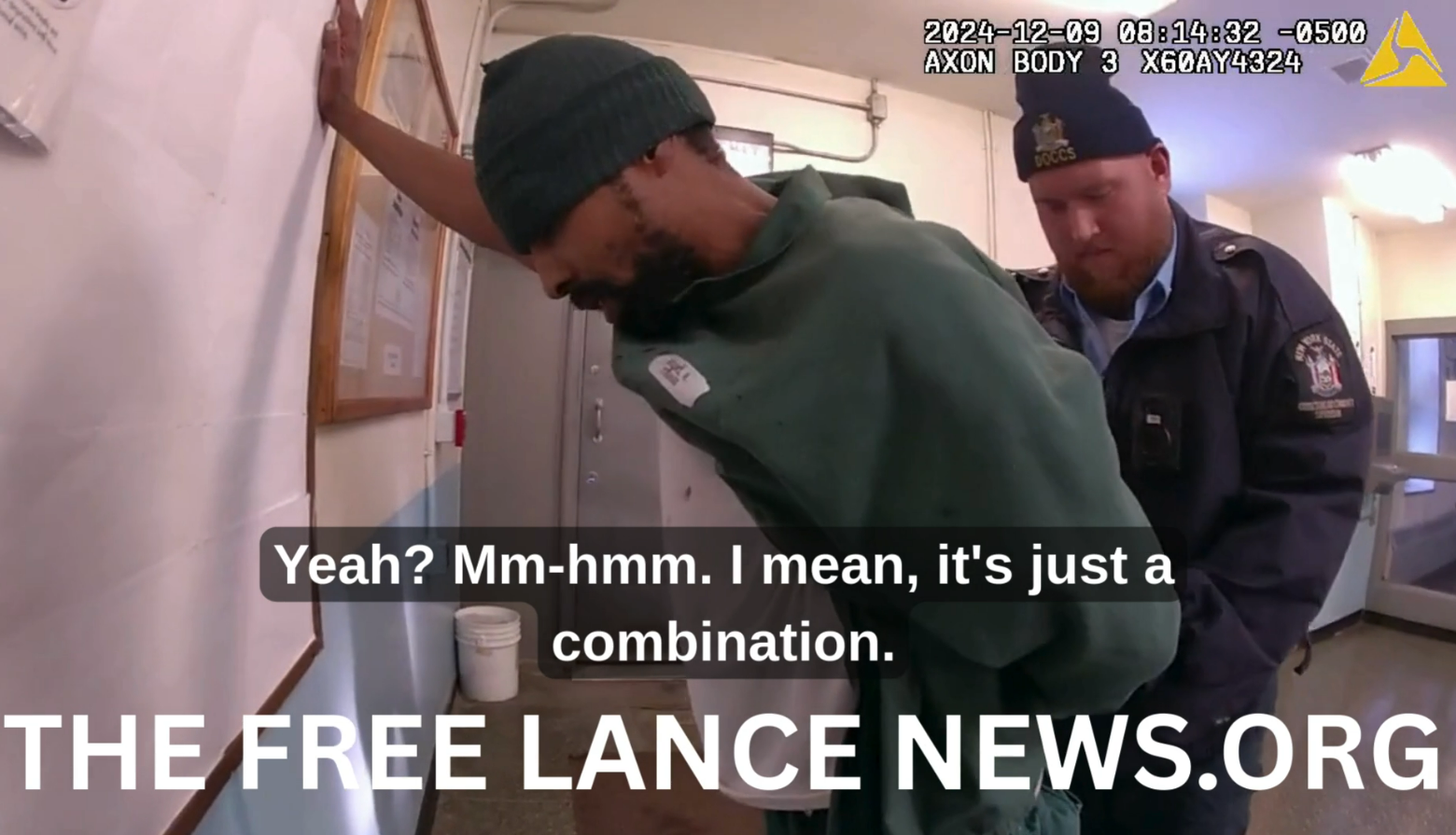
Body Camera video obtained by The Free Lance News captures a calm and compliant Robert Brooks hours before he was murdered by a beat-up squad of New York State prison guards at the Marcy Correctional Facility on Dec. 9, 2024. Photo credit: handout, via New York State Attorney General’s Office, video from the New York State Department of Corrections and Community Supervision.
MALONE, NEW YORK Mar. 4, 2026
EXCLUSIVE—Part 1 of The Robert Brooks Files, a multi-part investigation into the murder of Robert Brooks
The man in the video is physically slight and soft-spoken. He avoids eye-contact with the Corrections Sergeant speaking with him, keeping his eyes hidden under the low-slung brim of a scully. He can speak rationally, and make sense, but he also says things that do not make sense. Some might call him weird. Others queer. He may be mildly mentally-ill but mostly functional—or suffering from a concussion.
The one thing he definitely is not, at all, is aggressive or threatening. He may be "out there," but he's harmless.
He's Robert L. Brooks Sr.—the man at the center of a national scandal that shocked Americans because it forced them to realize that death squads, once considered an exclusive feature of foreign dictatorships, exist right here at home, on American soil. In fact, in a bastion of the Liberal Elite: New York.
For 15 months, gruesome but soundless body camera video capturing state prison guards beating and choking—torturing—Brooks to death has brought most of his killers to justice—but also reduced Robert Brooks the man to a voiceless, one dimensional murder victim.
To the upstate New York jury in Utica that acquitted two members of the squad of killing Brooks, he was a violent perpetrator who disobeyed orders.
Now, for the first time, Brooks speaks for himself—allowing the public to glimpse who he really was.
Body camera video captured by a sergeant who rescued Brooks after he was beaten for the second time in three days by prisoners at the Mohawk Correctional Facility hours before he was killed shows Brooks calmly speaking with officers and following their orders.
It's about 8:15 AM, Dec. 9, 2024. 12 hours later, Brooks was transferred to the nearby Marcy Correctional Facility. Though transferred there for his own protection, Marcy is where the 42-year-old Rochester native was killed.
Brooks was black; the gang of gaurds that killed him was all-white.
About half of the video was shown to the jury in the October 2025 murder, manslaughter and assault trial of state prison guards David J. Kingsley III, Mathew J. Galliher and Nicholas Kieffer. The jury convicted Kingsley of second murder and judge Robert Bauer sentenced him to 25-years-to-life; that same jury also totally acquitted Galliher and Kieffer.
Because New York law forbids the live broadcast of trials, the video is published for the public to see here for the first time. The parts that weren't played even for the jury are shown here for the very first time.
The 21-minute-and-five-seconds-long video begins with Brooks submitting to a pat frisk. He places his hands up against a wall in the kitchen area of a dormitory-style housing unit. He's just been attacked. His right eye is black and swollen and his nose is cut. Drops of blood dot his dark green state prison uniform sweater.
Sgt. David Sayyeau asks Brooks to state his name, which he does, followed by his state prison identification number.
The Correction Officer pat-frisking Brooks finds a combination lock in one pocket and a sock in another. An improvised weapon can be made by placing a lock in a sock. Sgt. Sayyeau asks Brooks why he has them in his pockets.
"'Cause they kept telling me they was gonna jump on me," Brooks answers.
"I had to take the lock to the airplane," he adds. "Gotta lock the combination to the airplane with your stuff on it."
When they handcuff Brooks behind his back he does not resist. When they walk him outside and put him in the back of a van he complies. He answers Sgt. Sayyeau's questions about the assault.
After, Sgt. Sayyeau goes back inside the dormitory and speaks with Correction Officer Sherri Abreu.
The Free Lance News previously reported Abreu set Brooks' murder in motion by having him beaten by other prisoners in the housing she was responsible for overseeing at Mohawk.
“This is Ms A the person who started the domino effect I truly believe if she didn’t get my dad jumped he never would have been transferred so he would be alive today,” Robert Brooks Jr., one of the murdered man’s sons, said in a Facebook statement after the report.
Abreu is named in a federal civil rights lawsuit Brooks jr. filed against 20 guards, two sergeants, two nurses and Daniel F. Martuscello III, the Commissioner of the Department of Corrections and Community Supervision, or DOCCS. DOCCS is responsible for managing all of New York's 42 prisons.
Abreu’s unease with Brooks is evident in the video. She didn’t tell Sgt. Sayyeau the attack on Brooks was a surprise. Instead, she explains why it happened.
"He comes to me," Abreu tells Sgt. Sayyeau, "and he's like talking some gibberish."
As Abreu talks, she points to a handful of paperwork stapled together and sitting on the shelf-like edge of the post. Its a list of previsouly-approved appointments prisoners may leave the dorm to attend. Its called a “call-out” list or sheet.
Sgt. Sayyeau motions to Abreu with his right hand to the body worn camera on his chest that is recording everything. Abreu subtly nods an acknowledgment.
"And he's pointing at this," Abreu continues, pointing to the callout list, "and it doesn't make sense."
The two then walk into the dormitory where Brooks was attacked.
First, Sayyeau inspects Brooks' living space, called a cube. Its bare. There aren't even sheets on the bed. Drops of blood dot the plastic, light green mattress.
"Shirts off, to the front of your cubes," Sgt. Sayyeau orders the 40 or so prisoners in the dormitory. "Hand and upper body check, show me your hands."
He goes around the dorm inspecting the mens' bare chests, backs and knuckles for cuts, swelling or abrasions—signs of a recent fight.
"A'ight, a'ight, a'ight, yep, yep, yep, a'ight ..." he says as he goes around.
Sgt. Sayyeau asks the men closest to Brooks' cube if they saw anything. Two say no. One says he doesn't speak English.
Back outside, Sgt. Sayyeau tells the Correction Officer watching Brooks in the van he's decided to take Brooks to the prison's protective custody unit for his own protection.
Sgt. Sayyeau gets in the van and asks Brooks if he had "any clue what this is over?"
"He told me to get out," Brooks answers. "He told me to get out."
Brooks continued: "I told him that um ... I told him that I'm about to go. That I gotta um... I got to get on the um ... plane. When I come back I move my stuff."
That's when the man assaulted him: "And he sucker punched me."
Sgt. Sayyeau asked Brooks if he punched back. Brooks said he didn't.
"I ain't gonna fight," Brooks answered. “It's not good."
Sgt. Sayyeau asks him what prison he was in before Mohawk. Brooks answered Wyoming.
"I loved Wyoming," Brooks said.
He was transferred from Wyoming to Mohawk for psychiatric treatment.
"I had stopped here for mental health," Brooks revealed.
Sgt. Sayyeau asked Brooks if he took "OMH meds," referring to the Office of Mental Health, which is responsible for administering psychiatric medication to patients in New York's prisons.
"I did it for a little while," Brooks answered, "I didn't like the way they feel."
The guards took Brooks into the infirmary for a medical examination.
As they waited, Sgt. Sayyeau kept Brooks talking. Brooks told Sayyeau he was first assaulted two days before, on Dec. 7.
"Someone attacked me while I sleep," Brooks told Sgt. Sayyeau. "Yeah about five, six" in the morning.
"The dude was from my city," he said. It was "totally different" from the attack on him that morning, Dec. 9.
Brooks told Sayyeau the man who punched him that morning belonged to a gang and told him he had to leave the housing unit.
"Them dudes in there be trying to run the dorm," Brooks explained. "Telling everybody what to do, cook, clean, I'm not about to have ..."
Brooks was still handcuffed. Sgt. Sayyeau had him uncuffed. Brooks promised to follow orders.
"Yes sir, Yes sir," Brooks answered.
Brooks sat calmly on the edge of an examination table waiting for a nurse to examine him. He complied with Sgt. Sayyeau's order to take his knit hat off so his head could be examined for injuries.
When the body camera stops it's 8:34 AM. Brooks was transferred to Marcy about 12 1/2 hours later—where he was killed by guards in 31 minutes.
“Watching this video breaks my heart because no son ever wants to see their father hurt or bullied,” Robert L. Brooks Jr. said in a statement. “But even in that moment, he was still joking and smiling. That was his strength. That was the kind of man he was.”
Send tips or corrections to jasonbnicholas@gmail.com or, if you prefer, thefreelancenews@proton.me