'THEY TOOK MY EYE': NEW YORK IS TORTURING PRISONERS—WITH LACK OF MEDICAL CARE
SISTER OF PRISONER WHO LOST EYE TO UNTREATED SKIN CANCER FORMS GROUP TO PUSH FOR NEW LAW MANDATING HUMANE PRISON MEDICAL CARE: THE JAY ACT ADVOCACY & LEGAL REFORM INITIATIVE
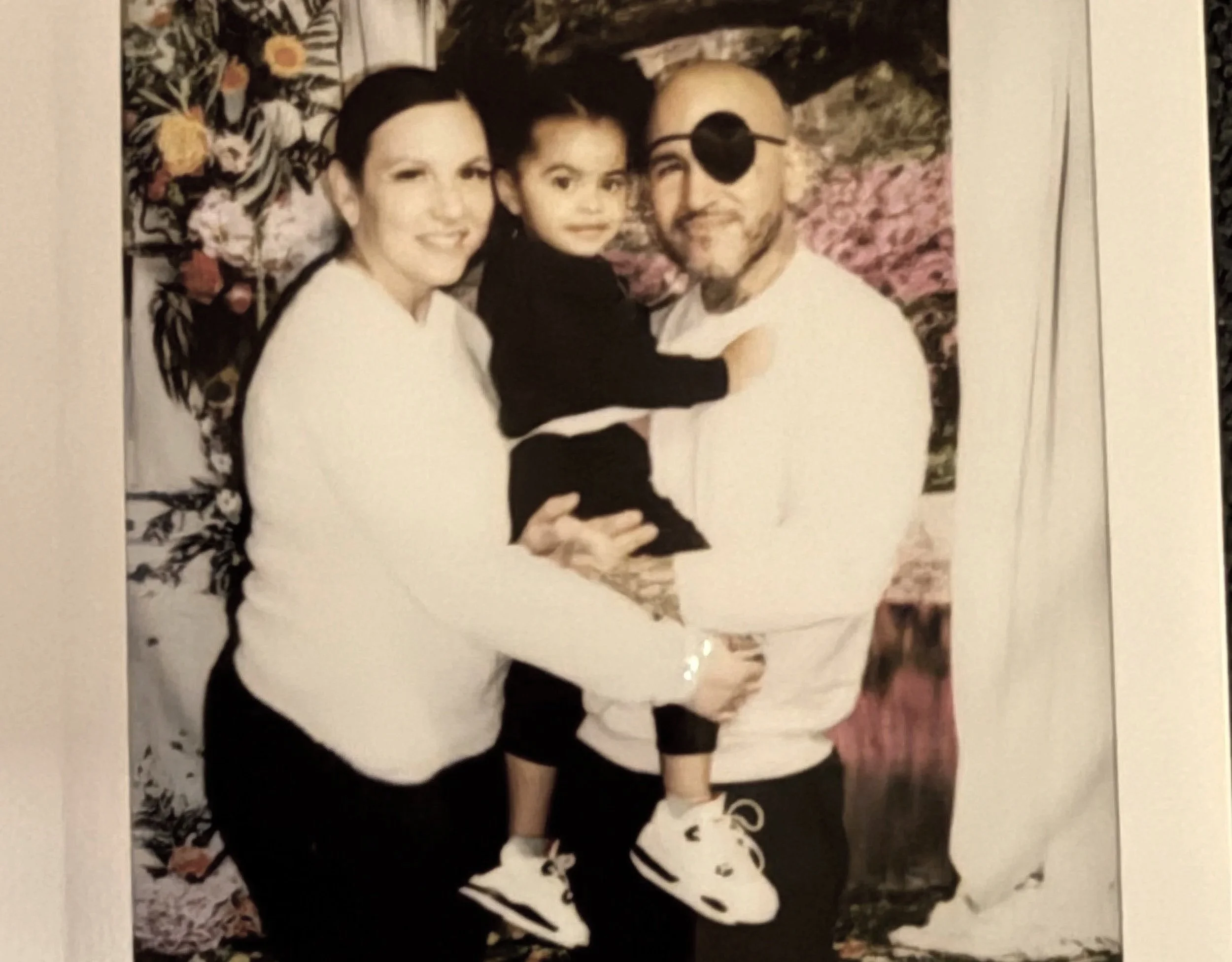
Stephanie Harris, her brother Jose “Jay” Rodriguez and Peyton at the Green Haven Correctional Facility. Photo credit: unknown, via Stephanie Harris.
Jose Rodriguez complained for years to doctors and nurses in New York's prisons about the abnormal growth on his eyelid.
When they failed to remove it, the Brooklyn native filed one complaint after another with prison officials, begging for proper medical treatment. Rodriguez's complaints crossed the desks of administrators in the prison he was incarcerated in, as well as the desks of higher-ranking state officials in Albany, where the state Department of Corrections and Community Supervision has its central office.
No one at DOCCS took Rodriguez's complaints seriously. All of them were ignored or denied.
Four years after he first complained about it, the growth turned into cancer and ate through his eyelid into his eyeball.
Finally, last month on May 22, Rodriguez was taken to a hospital where doctors removed the cancer—along with his left eye and surrounding tissue.
When he emerged from anesthesia in a recovery room, his sister, Stephanie Harris, was there.
"The handcuffs were placed on me real tight," Rodriguez told The Free Lance News on Sunday. "I remember my sister walking in, I started crying and telling her 'They took my eye!'"
Harris said she will never forget that moment until the casket closes on her corpse.
Standing there, looking down at the hospital bed, she didn't see a prisoner.
"I saw my brother," she said. "The anguish on his face. The realization everything he endured could have been prevented."
It was, she said, "a moment of profound pain."
Harris trembled with silent rage. In the crucible of that harrowing moment, a determination hard as steel was forged inside her.
"They will answer for what they did to you," she swore to her brother when she finally spoke.
Ever since guards at the Marcy Correctional Facility outside Utica murdered Robert Brooks on Dec. 9, 2024, the New York State prison system has been the subject of intense scrutiny by the public and lawmakers in Albany. They demanded answers: how did the system allow a beat-up squad of guards to turn into a death squad?
None of that scrutiny focused on the medical care New York’s prison system is legally and morally responsible for providing people in its custody—until now.
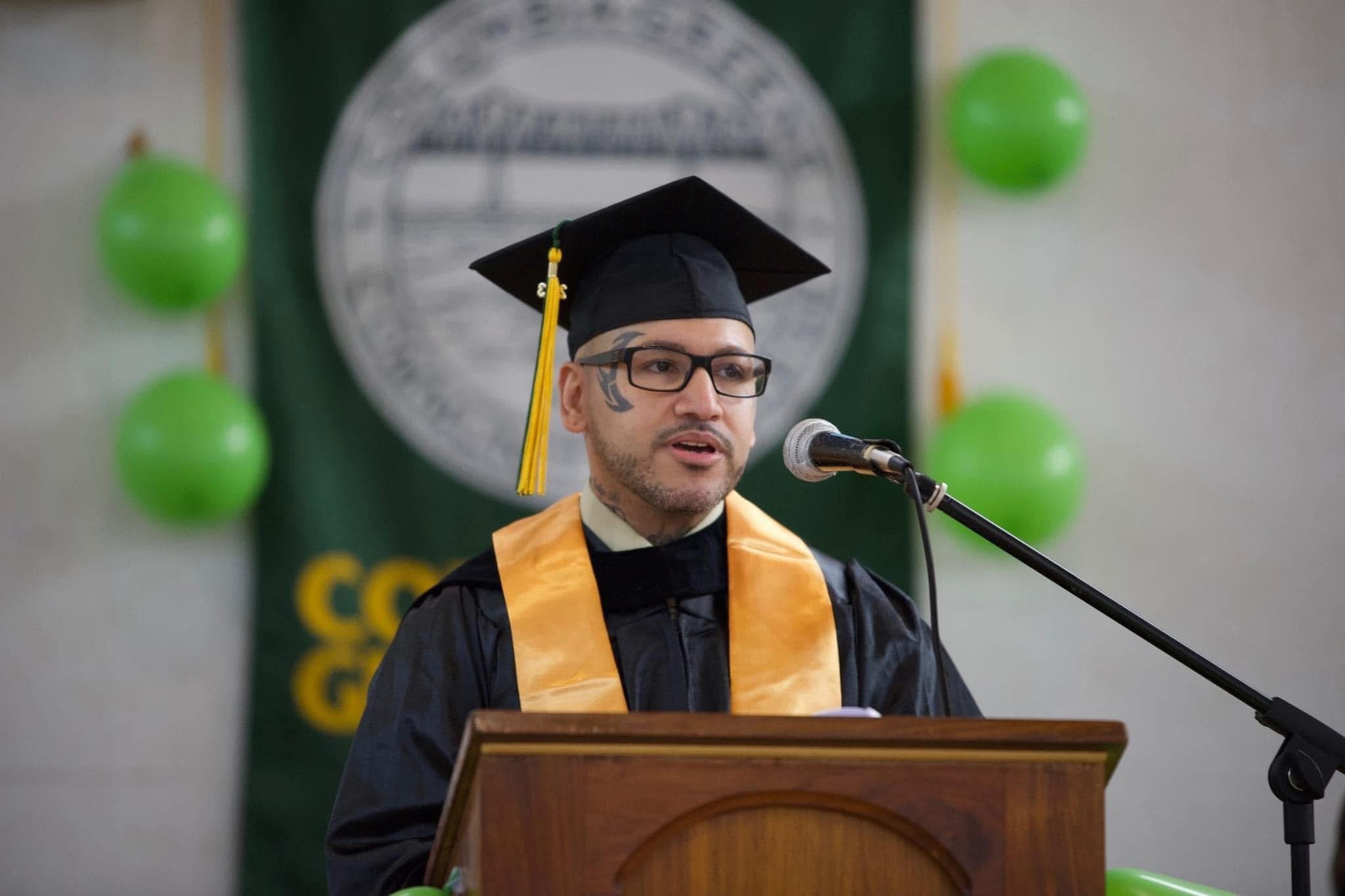
13 years into a 30-years-to-life sentence, Jose Rodriguez earned an associate’s degree from Columbia-Greene Community College through Hudson Link for Higher Education in Prison. He graduated with a 4.0 GPA. Now enrolled in SUNY New Paltz, Rodriguez is working towards a bachelor’s degree in sociology. Photo credit: unknown, via Rodriguez.
Convicted criminals are sent to prison as punishment, not for punishment.
That's because the Eighth Amendment to the US Constitution forbids "cruel and unusual punishments." In the 19th Century, the US Supreme Court held that means torture is forbidden.
In the 20th Century, the Court's landmark 1976 decision in Estelle v Gamble held for the first time that "deliberate indifference to serious medical needs" is tantamount to torture—and therefore also violates the Eighth Amendment.
"It has been torture," Rodriguez explained. "There were multiple nights in a row that I couldn't sleep due to the pain."
"There was also," he added, "the torture of finding out that what was happening to me was due to cancer and I was living with it for four years."
Rodriguez was and remains serving a 30-years-to-life sentence at Green Haven Correctional Facility, in the lower Hudson Valley. The walled, maximum-security prison was first built to house German prisoners of war during World War II.
"Medical care in Green Haven is the worst," Rodriguez says. "I've seen quite a few people die. Lives that could have been saved with basic medical care."
Right now, he said, "There are many that suffer with me. And if it doesn't get fixed, and there is no accountability, there's going to be many after me."
A total of 77 people have died in New York's prisons since Jan. 1, according to DOCCS. 53 are listed with an "unknown" cause of death. 18 are listed as having died of "natural causes." Rodriguez’s case suggests some of these may be due to sub-standard care.
9 of the 77 prisoners who died this year in the state’s prison system died at Green Haven. Seven of those 9 died from an "unknown cause," according to DOCCS. One died from a confirmed overdose and another died of "natural causes."
"2026 has seen the most in-custody deaths of any year since at least 2020, including during the COVID-19 pandemic," the 182-year-old and legislatively-empowered prison watch-dog group Correctional Association of New York said in May.
Jennifer Scafie, the Association's Executive Director, confirmed to The Free Lance News that "Complaints about medical care are among the most common that CANY documents during monitoring visits and through our hotline."
"It's fair to say,” Scafie added, "most incarcerated people we speak to find medical care in prison to be lacking in both quality and availability."
Michelle Bonet is a jailhouse lawyer-turned-justice advocate and founder of a Facebook group dedicated to facilitating oversight of New York's prisons she named "NYS DOCCS Federal Oversight."
"We are constantly trying to help people get proper medical treatment," the 52-year-old Bronx native said. "It definitely is a crisis."
Bonet laid part of the blame on the illegal, wildcat strike guards waged at almost every prison in the state for 22-days last year.
The strike ended with Gov. Kathy Hochul deploying the National Guard and firing about 2,000 guards. Since then, an additional 1,400 have retired, quit or been fired. Soldiers remain deployed at a staggering cost of at least $1.2 billion through 2027 alone.
"When we have the National Guard at such a price tag, there's ample staff to ensure everyone makes their appointments," Bonet argued. "There's no excuse for delays like in Rodriguez's case."
Still, only guards are trained to safely transport inmates outside prisons and it takes two to make one trip. Prison administrators may be having trouble sufficiently staffing those trips.
Tom Mailey, spokesperson for DOCCS, did not respond to an inquiry specifically asking whether staffing shortages were the reason it took so long for Rodriguez to be treated at a hospital outside the prison.
Michelle Bonet served five years in New York’s prisons. Inside, she learned the law. After she was released, she founded a Facebook group called “NYS DOCCS Federal Oversight,” dedicated to public oversigned of the New York State prison system. Photo credit: unknown, via Bonet.
Rodriguez reports the cancer first appeared on his eyelid in March or April of 2022. He was screened by a nurse, but not treated.
"It was pretty much ignored," Rodriguez says. "I kept complaining about it."
After two years without treatment, "My eyelid started to notch. I kept on complaining."
Rodriguez says prison nurses told him he "had to see a optic plastic surgeon but that was never done."
"The condition kept getting worse," he says. In March 2025, "Everything went super downhill really fast."
That's when, he says, "my eyelid—it was already notched—it shifted. Half of my eye shifted to where my eyelashes were going into my cornea, rubbing against my cornea."
Finally, he was taken out of the prison and transported to the Westchester County Medical Center. Rodriguez says a doctor there told him: "You have a mass on the inside of your eyelid. You need to come back to a follow up."
He was not taken back until August 2025.
This time a different doctor told him the mass had grown. This doctor said Rodriguez had to be brought back again. When he was, he saw the doctor who examined him the first time.
"I was supposed to see you months ago," she told him, he says.
This time, the original doctor was alarmed by what she saw. She called another doctor for a second opinion. That doctor examined Rodriguez and confirmed it "looks like some sort of cancer," Rodriguez says.
That was the first time he heard the dread word.
Another month went by until the mass was biopsied Oct. 1. It took until the end of October for prison doctors at Green Haven to tell Rodriguez he had squamous cell carcinoma.
Meanwhile, the mass became infected. The prison took him back to the hospital for intensive treatment.
"My condition kept on worsening," Rodriguez says.
He filed a grievance complaint over the lack of treatment that led to the infection. Green Haven's superintendent denied it, finding Rodriguez "received appropriate medical care."
He was not seen by another doctor until January. That's when a fifth doctor discovered "the tumor was now attached to my eyeball."
That doctor referred Rodriguez to a sixth doctor. Another month went by.
Rodriguez finally saw the sixth doctor in February. That doctor told him there wasn't anything that could be done to save his eye.
The sixth doctor referred him to yet more doctors: cancer specialists at Sloan Kettering Westchester.
A month later, Rodriguez says, "They confirmed the cancer has metastasized deep into the eyeball."
Rodriguez finally had the surgery on May 22—four years too late.
Afterward, the surgeon told him he had to "really cut deep into the tissue and we're still waiting for the pathology report."
Doctors have not yet declared him cancer-free.
"Its been a nightmare," he says. "This has been a complete nightmare for me. I'm still suffering from nightmares because of it. And now I'm dealing with the anxiety of losing my eye."
Mailey, spokesperson for DOCCS, responded to The Free Lance News's inquiry about DOCCS' treatment of Rodriguez.
In an email he said: "The Department provides incarcerated individuals with the community standard of care, including the opportunity to see a medical professional through the facility’s sick-call procedure, and are transported to a local hospital when their medical needs are beyond the scope of what can be provided in the facility."
He added: "DOCCS has agreements with health care providers and specialists at major hospitals across the state, as well as agreements with several smaller hospitals in close proximity to its facilities to ensure the medical needs of incarcerated individuals are met."
Finally, Mailey said, "DOCCS does not comment on the medical care of an incarcerated individual."

Jose Rodriguez was incarcerated at New York’s maximum-security Green Haven Correctional Facility, when an abnormal skin growth on his eyelid turned to cancer and ate into his eye because officials failed to properly treat it for four years. Green Haven was originally built to house German prisoners of war during World War II. Pictured here in 2015. Photo credit: JB Nicholas.
At first, Rodriguez didn't want to bother his younger sister with his prison problems.
He knew she was busy running operations for a major corporation along the mid-Atlantic coast, and raising a teenaged son set on becoming a pro football star. He turned to their mother for help instead. In December 2024 Rodriguez asked her to start telephoning and emailing prison officials until he got proper medical treatment.
Officials at Green Haven and in DOCCS' Central Office in Albany blew her off—for 15 months.
Finally, in March 2026, mother turned to daughter for help.
"I tried writing the facility. I tried contacting the superintendent. I tried calling there. I tried making complaints to Albany. Calling Albany. I just got passed along," Harris explained. "And that's exactly what happened to our mother."
As Harris transformed herself from business executive into a present-day Florence Nightingale for prisons, she was guided by a woman who spent five years “behind the wall” in New York: Bonet, founder the NYS DOCCS' Federal Oversight Facebook group. Bonet helped Harris get her brother the surgery.
Basically, she showed Harris how to communicate effectively with prison officials. She mapped the opaque prison bureaucracy for her then helped her navigate it. Dealing with prison officials was tricky, Bonet explained: "They tend to make things worse before they make it better."
"I helped her figure out the right people to reach to trigger the right reaction at the right time," she added.
Two months after Harris started advocating for her brother, Rodriguez was finally operated on.
Rodriguez told The Free Lance News he hoped his story inspired "policy change, transparency, and accountability. This situation is bigger than me."
His sister calls it "turning pain into policy."
Harris named the group she founded to advocate for her brother and others the Jay Act Advocacy & Legal Reform Initiative. Its first mission is to help individual prisoners obtain necessary medical care. She's already helping many.
"A lot of these people don't have families," Harris explains. "Or their families are not educated on the 'know how'" of effectively advocating for loved ones.
The initiative's second mission is to to convince federal and state legislators to pass new laws mandating timely and proper medical treatment for serious injuries and illnesses—"The Jay Act."
"This is a real David vs. Goliath situation," Harris declared. "I am not afraid."
For tips or corrections, The Free Lance can be reached at jasonbnicholas@gmail.com or, if you prefer, thefreelancenews@proton.me.