NURSE TESTIFIES IN DEFENSE OF LAST STATE PRISON GUARD CHARGED WITH KILLING ROBERT BROOKS
CLOSING ARGUMENTS HEARD IN THE MANSLAUGHTER PROSECUTION OF MICHAEL FISHER AFTER KYLE DASHNAW TESTIFIED
Former New York State prison guard MIchael Fisher smiling as other guards murder Robert Brooks in front of him at the Marcy Correctional Facility Dec. 9, 2024. Prosecutors showed the image during closing arguments at Fisher’s manslaughter trial in Oneida County Court Jan. 15, 2026. Photo credit: JB NIcholas.
UTICA, NEW YORK Jan. 15, 2025
The jury deciding the fate of a former New York state prison guard charged with manslaughter for killing a black inmate started deliberating after hearing closing arguments Thursday morning.
Michael D. Fisher, a former guard at the Marcy Correctional Facility outside Utica, is charged with manslaughter for facilitating and failing to stop the killing of Robert Brooks by an all-white group of guards Dec. 9, 2024.
“For seven minutes—seven gut-churning, nauseating, disgusting minutes—he stood in that room close enough to touch him, and he did nothing,” special prosecutor Onondaga County District Attorney William F. Fitzpatrick told jurors.
Fitzpatrick also showed jurors an image of Fisher smiling his approval during the lethal attack.
Fisher’s defense lawyer, Scott Iseman, painted a picture of Brooks as a dangerous criminal who refused orders, kicked other guards and even bit one. As a law enforcement officer, Fisher was entitled to be excused even if he did something that, in hindsight, was wrong.
"You have to give this officer an allowance," Iseman argued.
The jury did not include a single Black person, although Black people live in Oneida County, where the trial was held.
To the prosecution, Fisher coldly stood by and did nothing despite a legal duty to stop his co-workers from punching Brooks repeatedly, stomping on his groin repeatedly and repeatedly choking him until Brooks had a fatal heart attack.
Fitzpatrick, the special prosecutor, replied to Iseman's argument Fisher was entitled to the benefit of the doubt because he was a law enforcement officer by telling the jury Brooks' killing "had nothing to do with law enforcement."
It was instead, Fitzpatrick charged, "a gut-wrenching, disgusting, overwhelmingly improper, illegal, criminal snuffing out of a human being." Brooks was not a real danger to the guards, the special prosecutor said, he was instead a "148-pound, unarmed, shackled, human being."
On Wednesday, two former Marcy guards testified prisoners were regularly beat and guards regularly lied to cover those unjustified or excessive beatings up. Thursday, the fourth day of Fisher's trial, started with the testimony of nurse Kyle Dashnaw—who regularly treated victims of these beatings.
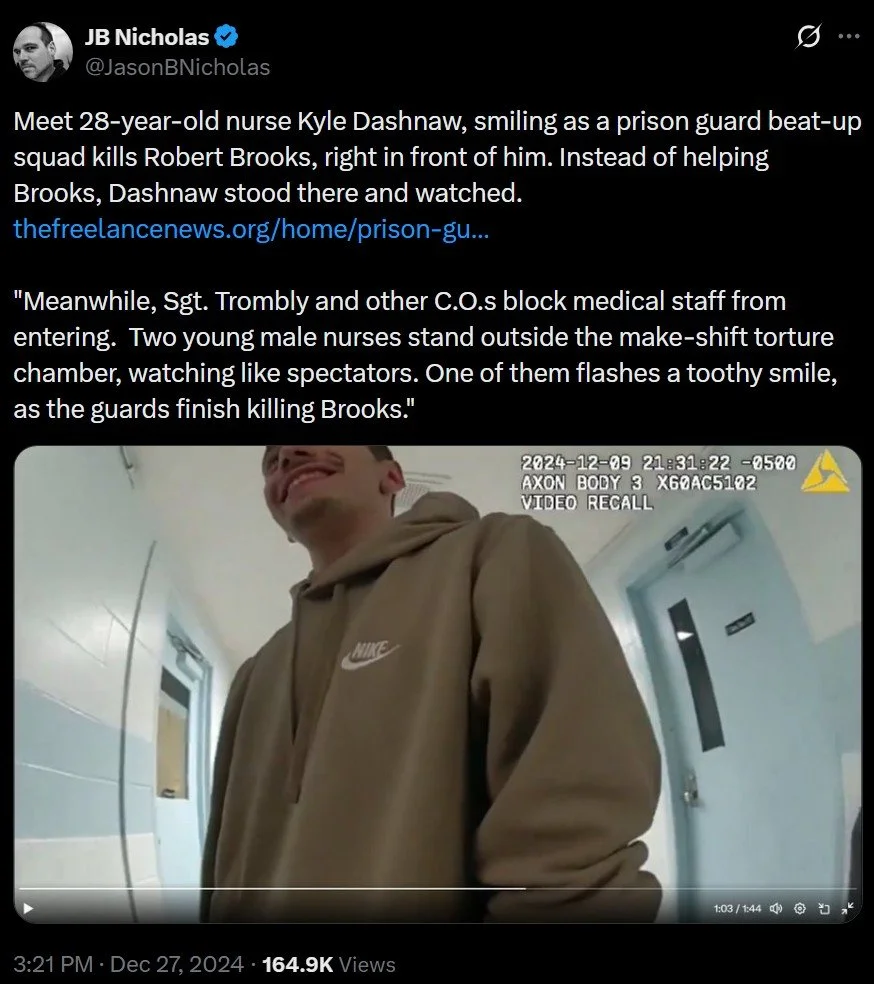
Dashnaw was a nurse at Marcy working inside the infirmary when Brooks was killed. Body-camera video captured Dashnaw smiling while Brooks was killed. He was ordered by guards to stay outside the treatment room where Brooks was killed, called the "emergency room," and Dashnaw silently complied.
Called by Fisher as a witness to testify in his defense on Thursday, Dashnaw testified the extent of Brooks' internal injuries were not immediately apparent to him when he was finally allowed to treat Brooks after the beating. Dashnaw also said Brooks' vital signs were stable at that time.
Minutes later, however, Dashnaw said Brooks' heart stopped beating, emergency first-aid was started and an ambulance was called. Brooks was taken to Wynn hospital in Utica, where he was formally declared dead about five hours later.
Dashnaw lost his job at Marcy, but kept his state nursing license.
Dashnaw was hired by Rome Health Hospital in Rome, New York. He started work there in August 2025, Dashnaw testified.
The Free Lance News has long had questions for Dashnaw and finally caught up with him after he testified. Dashnaw stayed silent.
Iseman, Fisher's lawyer, cited Dashnaw's testimony and suggested if Dashnaw couldn't see the true extent of Brooks's injuries when he first saw Brooks neither could Fisher.
But Fisher saw most of the beating, while Dashnaw did not.
Former New York state prison nurse Kyle Dashnaw before he testified in the defense of MIchael Fisher, a former New York state prison guard charged with manslaughter for failing to stop the killing of Robert Brooks. Photo credit: JB Nicholas.
Fitzpatrick, the special prosecutor, responded to FIsher’s defense by arguing the risk to Brooks's life was obvious and "foreseeable to anybody with a brain, two eyes, conscious—nevermind a correction officer for 20 years."
"Is there any sentient human being that can look at this and not realize what is happening?," Fitzpatrick added.
Fitzpatrick openly mocked Fisher's defense.
"Gee I can't see anything wrong with Mr. Brooks—can you?," Fitzpatrick sarcastically told the jury while he played the body-camera video that captured Brooks' killing on a large-screen TV in the courtroom.
Guards punched, stomped and choked Brooks while Brooks slipped in-and-out of consciousness and blood flowed from his nose, the video showed.
All "while Fisher stands there and doesn't do a damn thing," Fitzpatrick added.
Iseman, Fisher's lawyer, tried to turn the video against the prosecution with a crafty argument.
Iseman told the jury that the more times it had to view the video to reach agreement on what it showed, that its need for more clarity was evidence in itself that Fisher was not guilty because "real life does not have a re-wind button. Real-life does not have a pause button."
"Every single time you pause to get a closer look, that's a reasonable doubt. Every single time you re-wind to get a different perspective, that is a reasonable doubt," Iseman argued. "Every single time someone asks to see it again, is a reasonable doubt because you can't use hindsight and he didn't get to look at it again."
Fitzpatrick replied to that argument by saying it was the first time in his 40 years as a prosecutor a defense lawyer had told a jury "if you look carefully at the evidence that manifestly must return a verdict of not guilty."
Mere minutes after they began deliberating, the jury sent out a note asking to re-watch the video.
The judge presiding over the trial, Oneida County Court judge Robert L. Bauer, released the jury for the day shortly after 4:00pm. He told them to return at 10:00pm on Friday to continue deliberating.
Send tips or corrections to jasonbnicholas@gmail.com or, if you prefer, thefreelancenews@proton.me